



Hyundai E&C and KOEN to jointly develop coal plant-linked SMR technology
Jun 21, 2026, 09:30 am


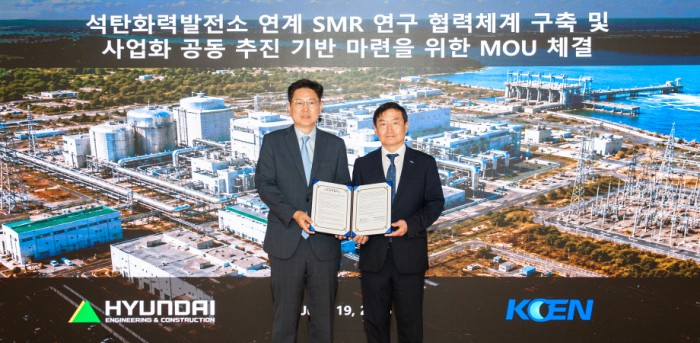 |
| Choi Young, head of the New Energy Business Division at Hyundai Engineering and Construction (left), and Lee Young-ki, Vice President of Safety and Technology at Korea South-East Power, take a commemorative photo after signing a memorandum of understanding for cooperation on 'Joint Research and Commercialization of Small Modular Reactors (SMR) Linked to Coal-Fired Power Plants' at the Hyundai E&C headquarters in Gye-dong, Jongno-gu, Seoul, on the 19th. |
On the 19th, Hyundai Engineering and Construction, together with Korea South-East Power, signed a memorandum of understanding for cooperation on the 'Joint Research and Commercialization of Small Modular Reactors (SMR) Linked to Coal-Fired Power Plants' at the Hyundai E&C headquarters in Gye-dong, Jongno-gu, Seoul.
With this agreement as a catalyst, the two companies will begin developing technology to replace boilers at coal-fired power plants scheduled for phased retirement under the government's carbon-free power expansion policy, thereby reusing generation facilities to produce energy. Through this, they also plan to explore the feasibility of demonstrating and commercializing SMR-based power generation businesses that utilize the idle infrastructure of coal-fired power generation.
To this end, the two companies will cooperate on: developing technologies for installing and utilizing SMRs linked to coal-fired power generation facilities and sites; sharing information such as power generation operation technology, equipment, and field data; and operating a working-level consultative body to promote joint research and commercialization.
In particular, they plan to focus on concrete embodying a carbon-free power-based comprehensive energy plant model by reviewing the technical and economic feasibility of the 'retrofit' method, which utilizes existing power plant sites and facilities.
Retrofitting is a method of replacing core equipment or improving performance, efficiency, and safety through new technologies or additional devices while maintaining existing facilities. It is drawing attention as a way to increase the utilization of existing power generation infrastructure during the energy transition process.
An official from Hyundai E&C said, "This agreement is significant in that it combines next-generation reactor technology with existing power generation infrastructure to discover business models needed in the era of energy transition," adding, "To develop power sources that will lead the future energy market, we will create tangible cooperative results based on Hyundai E&C's nuclear power technology competitiveness and Korea South-East Power's power generation operation know-how."
Lee Su-il
Most Read
-
1
Kia Sportage outperforms Mazda CX-5 in German auto..

-
2
Houthis launch successive attacks on Saudi airport..

-
3
Saudi Arabia, Iran hold first diplomatic talks to..

-
4
Saudi airport in Riyadh struck again, leaving at l..

-
5
U.S. deploys carrier, 10,000 more troops to Middle..

-
6
Five ASEAN countries welcome Myanmar coup leader

-
7
Putin's ally visits China on the 8th ahead of APEC..

PEOPLE






HEADLINE NEWS
- New White House Press Secretary links $54 billion from Seoul to Alaska LNG in first briefing
- Industrial Bank of Korea launches local subsidiary in Vietnam
- Saudi-Houthi clashes over oil facilities escalate, hitting 24 vessels in Ho..
- Bin Salman underestimates Houthi offensive, imperiling Saudi economic refor..

-
Address : In-Young Bldg., 34, Uisadang-daero 1-gil, Yeongdeungpo-gu, Seoul
Copyright by ASIATODAY CO., LTD. All rights resereved