



80% of firms grade internal controls 'adequate' despite adverse auditor opinions
Jun 17, 2026, 11:10 am


 |
| Deloitte Korea Group |
Eight out of ten listed South Korean companies that received an adverse opinion on their internal control over financial reporting (ICFR) from external auditors were found to have self-rated their systems as adequate by their own management and audit committees. Amid this glaring discrepancy between internal and external assessments, misconduct by top management was identified as the leading cause of internal control deficiencies.
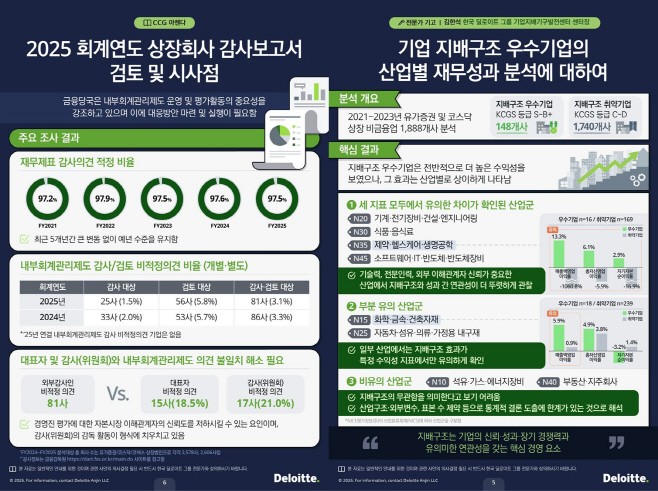
The Center for Corporate Governance at Deloitte Korea published these findings on June 17 in its report, "Corporate Governance Insights No. 14," which analyzed the audit reports of 2,606 companies listed on the KOSPI, KOSDAQ, and KONEX markets for the 2025 fiscal year.
According to the report, a total of 81 listed companies (3.1%) received non-unqualified—either adverse or qualified—audit or review opinions from external auditors regarding their ICFR for the last fiscal year. A total of 331 specific grounds for the non-unqualified opinions were flagged across these firms from an internal control perspective.
The largest single factor was executive misconduct, accounting for 24.5% of the total cases. This was followed by scope limitations (15.1%), financial statement revisions during the current audit process (10.6%), deficiencies in controls over non-routine transactions (9.4%), and deficiencies in funds controls (8.2%).
Notably, 60 companies—or 74% of the 81 firms flagged for weak internal controls—also received non-unqualified opinions on their financial statement audits, demonstrating a strong correlation between internal control vulnerabilities and the unreliability of financial reporting.
Despite such severe vulnerabilities in internal controls, self-regulatory mechanisms and internal evaluations within these corporations were virtually non-existent. Out of the 81 companies given a non-unqualified internal control grade by external auditors, only 15 (18.5%) had management teams that proactively issued a non-unqualified self-assessment. Similarly, audit committees or auditors issued a non-unqualified opinion in only 17 companies (21.0%). In stark contrast, 81.5% of management teams and 79.0% of audit committees concluded in their internal reports that their ICFR was operating adequately.
"To resolve the valuation mismatch between external auditors, management, and audit committees, reliable self-evaluations and transparent communication are indispensable," said Kim Han-seok, leader of the Center for Corporate Governance at Deloitte Korea. He added, "Since a governance structure capable of checks and balances serves as the core infrastructure for sustainable corporate growth, companies must enhance the practical effectiveness of their internal controls through robust and substantive oversight activities."
Han Hye-sung
Most Read
-
1
Kia Sportage outperforms Mazda CX-5 in German auto..

-
2
Houthis launch successive attacks on Saudi airport..

-
3
Saudi Arabia, Iran hold first diplomatic talks to..

-
4
U.S. deploys carrier, 10,000 more troops to Middle..

-
5
Saudi airport in Riyadh struck again, leaving at l..

-
6
Putin's ally visits China on the 8th ahead of APEC..

-
7
Chinese military support and training center opens..

PEOPLE






HEADLINE NEWS

-
Address : In-Young Bldg., 34, Uisadang-daero 1-gil, Yeongdeungpo-gu, Seoul
Copyright by ASIATODAY CO., LTD. All rights resereved