



Korean banks’ Q1 net profit slips on bond losses
May 20, 2026, 09:11 am


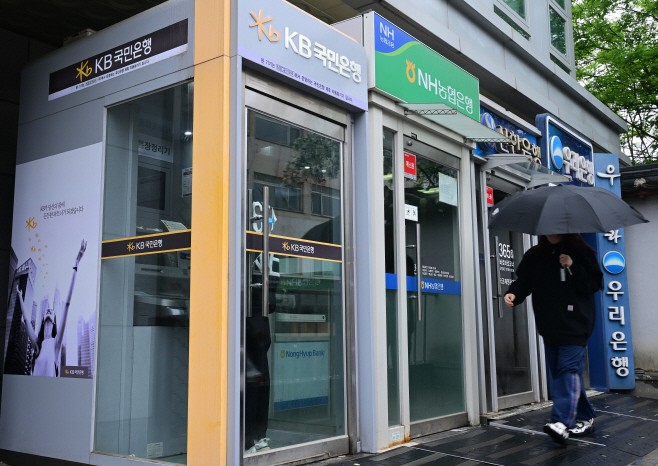 |
| Bank ATMs installed in downtown Seoul. /Reporter Lee Byung-hwa |
The net profit of South Korea’s domestic banks declined slightly in the first quarter of 2026 despite improved interest margins, as losses from securities holdings weighed heavily on non-interest income.
According to preliminary data released by the Financial Supervisory Service on May 20, domestic banks posted a combined net profit of 6.7 trillion won in the January-March period, down 300 billion won from 6.9 trillion won a year earlier.
General banks recorded net profit of 4.3 trillion won, up 100 billion won from a year earlier. While internet-only banks and regional banks saw earnings growth, major commercial banks posted a slight decline of about 20 billion won. Special-purpose banks reported net profit of 2.4 trillion won, down 300 billion won year-on-year.
Profitability indicators also weakened overall. Banks’ return on assets (ROA) stood at 0.64% in the first quarter, down 0.07 percentage point from a year earlier, while return on equity (ROE) fell 0.89 percentage point to 8.68%.
Interest income continued to grow. First-quarter interest income reached 15.8 trillion won, up 1 trillion won year-on-year, supported by growth in interest-earning assets such as loans and improvements in net interest margin (NIM). Interest-earning assets rose 4.8% to 3,556 trillion won, while NIM improved by 0.03 percentage point to 1.56%.
However, non-interest income fell sharply. Non-interest income dropped by 700 billion won year-on-year to 1.3 trillion won, largely due to expanded valuation losses on securities holdings caused by rising market interest rates. Securities-related profit swung to a loss of 1.2 trillion won during the quarter.
The yield on three-year Korean Treasury bonds rose from 2.951% at the end of last year to 3.557% at the end of March, an increase of 0.606 percentage point. Rising yields typically lower bond prices, resulting in valuation losses for banks holding securities portfolios.
Meanwhile, fee-based and trust-related businesses improved. Fee income rose 10.1% year-on-year to 1.5 trillion won, while trust-related profit jumped 48.6% to 500 billion won. Foreign exchange and derivatives-related income also returned to profit, reaching 2.3 trillion won.
Banks’ expenses increased moderately. Selling and administrative expenses totaled 7.2 trillion won in the first quarter, up 400 billion won from a year earlier. Labor costs increased by 100 billion won to 4.3 trillion won, while other operating expenses rose by 200 billion won to 2.8 trillion won.
Credit loss expenses declined. Domestic banks’ loan-loss provisioning costs fell by 300 billion won year-on-year to 1.4 trillion won. General banks accounted for 1 trillion won of the total, while special-purpose banks recorded about 400 billion won.
The Financial Supervisory Service said it would continue encouraging banks to strengthen their loss-absorption capacity amid growing domestic and external uncertainties.
“Based on solid profitability, we will continue to encourage banks to faithfully fulfill their social and public responsibilities, including productive financing and inclusive finance,” an FSS official said.
#Korean banks #net profit #NIM #bond losses #securities valuation loss
Copyright by Asiatoday
Most Read
-
1
Celltrion’s Omlyclo gains ground in major European..

-
2
Trump demands rates fall below 1% as Fed hikes for..

-
3
Trump makes $1 trillion bet ahead of midterm elect..

-
4
Iran resumes ballistic missile production, assembl..

-
5
Samsung Electronics, Mistral AI to jointly develop..

-
6
Trump warns countries not helping U.S. must pay re..

-
7
Apple launches first foldable, 1 million won prici..

PEOPLE






HEADLINE NEWS
- Trump to roll out ‘unprecedented welcome’ for Xi with B-2 bombers, F-22 fighters
- S. Korea, U.S., and Japan form united front on Taiwan and economic coercion..
- Trump administration moves to impose sweeping sanctions on International Cr..
- Xi to make state visit to U.S. Sept. 23-25, dispelling rumors over his heal..

-
Address : In-Young Bldg., 34, Uisadang-daero 1-gil, Yeongdeungpo-gu, Seoul
Copyright by ASIATODAY CO., LTD. All rights resereved