



Atlas lifts 23kg fridge, signaling earlier mass production of humanoids
May 19, 2026, 05:51 pm


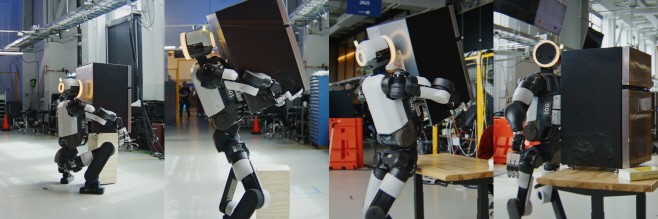 |
| Boston Dynamics' humanoid robot, Atlas, delivers a whole refrigerator in a video released on the company’s YouTube channel on May 18 (local time). / Captured from Boston Dynamics’ YouTube channel |
Boston Dynamics' humanoid robot, Atlas, has successfully carried a refrigerator weighing 23kg with remarkable stability, sparking assessments that its deployment in industrial fields is now within sight. The Hyundai Motor Group also accelerated the expansion of its robotics value chain by announcing plans to deploy over 25,000 Atlas units into its manufacturing plants.
On May 19, Boston Dynamics released a video on its official YouTube channel showing Atlas lifting and moving a small refrigerator.
In the video, Atlas bent its knees to lift the 23kg refrigerator, picked it up securely with both arms, maintained its balance while walking, and carefully placed the object on a table. Notably, it executed a natural 180-degree upper-body rotation, demonstrating movements highly applicable to actual work environments.
According to Boston Dynamics, Atlas also successfully carried a 45kg object during a stress test conducted the previous day, which exceeded its standard trained parameters. Experts evaluate that this milestone proves the robot's whole-body control capabilities and external object manipulation skills required on production floors.
The core of this demonstration lies not in brute strength, but in physical intelligence driven by "Physical AI." Utilizing tactile-based feedback and deep reinforcement learning (RL), Atlas does not rely solely on visual data. Instead, it adjusts to load changes and tactile information in real-time upon contact to maintain balance. This means the robot can distribute its strength and move autonomously without having to calculate the object's center of gravity beforehand.
The hardware architecture has also been simplified for mass production. By utilizing only two types of rotary actuators across its entire body, the robot achieves higher simulation efficiency and reduced manufacturing costs. This streamlined structure has significantly narrowed the gap between the virtual environment and the physical robot, establishing a pipeline where actions learned in simulation translate almost identically to the actual hardware.
Industry insiders analyze that these developments signal the imminent mass production of Atlas.
During a corporate briefing for overseas institutional investors held in Boston on May 18 (local time), the Hyundai Motor Group unveiled its plan to introduce more than 25,000 Atlas units to Hyundai Motor and Kia production lines. However, the specific timeline for deployment and the choice of manufacturing facilities were not disclosed.
Alongside the deployment, the group plans to establish a production facility in the United States capable of manufacturing 35,000 actuators annually. The facility aims to begin operations by 2028, with speculation rising that Hyundai Mobis, which oversees key component supplies for Atlas, will manage the plant.
On the same day, Hyundai Mobis held the "5th Mobis Mobility Day" near Silicon Valley, California, to expand global partnerships in the fields of robotics and Physical AI. The event drew a large crowd of automotive industry officials and investors, where Hyundai Mobis shared its robotics investment strategies alongside achievements in autonomous driving and Software-Defined Vehicle (SDV) technologies.
"Hyundai Motor Group is actively building a robotics value chain by connecting Boston Dynamics' technology, Hyundai Mobis' key component manufacturing, and the group's own production plants as testing grounds," an industry insider remarked. "The era of full-scale mass production is drawing near."
Most Read
-
1
Kia Sportage outperforms Mazda CX-5 in German auto..

-
2
Houthis launch successive attacks on Saudi airport..

-
3
Saudi Arabia, Iran hold first diplomatic talks to..

-
4
U.S. deploys carrier, 10,000 more troops to Middle..

-
5
Saudi airport in Riyadh struck again, leaving at l..

-
6
Putin's ally visits China on the 8th ahead of APEC..

-
7
Chinese military support and training center opens..

PEOPLE






HEADLINE NEWS

-
Address : In-Young Bldg., 34, Uisadang-daero 1-gil, Yeongdeungpo-gu, Seoul
Copyright by ASIATODAY CO., LTD. All rights resereved