



Chinese press points to "subtle rifts" beneath surface of Korea-Japan diplomacy
May 19, 2026, 04:57 pm


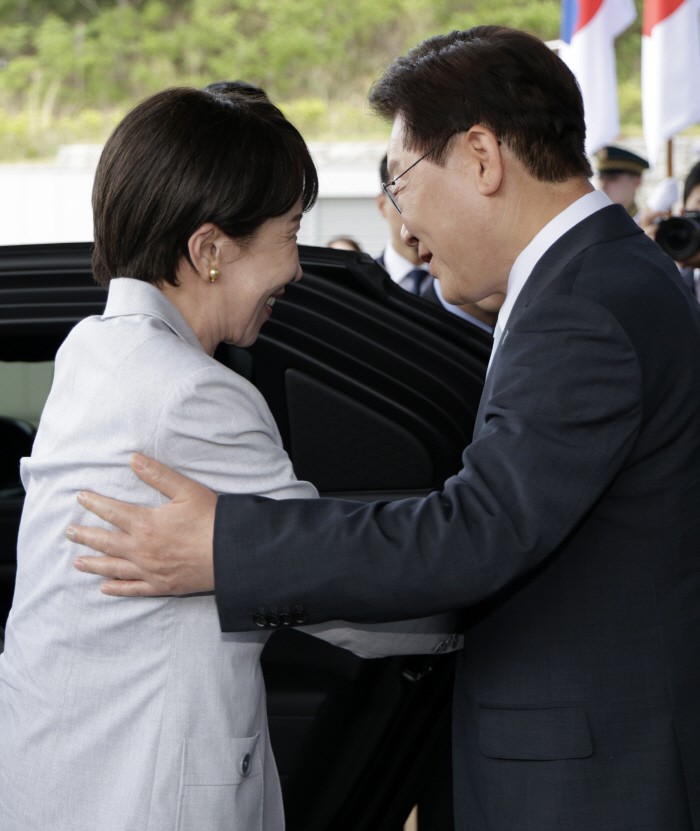 |
| South Korean President Lee Jae-myung welcomes Japanese Prime Minister Sanae Takaichi at a hotel in Andong, Gyeongbuk, on May 19. / Yonhap |
Chinese state media analyzed that the "shuttle diplomacy" between the leaders of South Korea and Japan on May 19 reflects Japan's thoroughly calculated self-interest.
On May 18, the Global Times, a Chinese state-run English-language daily, published an op-ed titled "Different Temperatures in South Korea-Japan Shuttle Diplomacy."
The piece pointed out the background and limitations of the accelerating shuttle diplomacy, assessing that a "difference in temperature" remains unresolved beneath the friendly atmosphere between the two leaders.
The Global Times reported that Japan's outreach to South Korea is backed by a clear anti-China motive. However, amid deteriorating Sino-Japanese relations, President Lee Jae-myung is refraining from taking sides.
The media outlet also noted that relations between Beijing and Tokyo have worsened sharply since Japanese Prime Minister Sanae Takaichi's remarks regarding Taiwan last November. It analyzed that Japan is striving to stabilize relations with South Korea, its other neighbor, to avoid isolation in Northeast Asia.
The report explained that South Korea has also made a pragmatic choice to maintain the pro-Japan policy stance of the previous administration in order to minimize diplomatic risks amid global uncertainties.
Changes in the U.S. posture and instability in the Middle East also played a role, according to the report.
The U.S. strikes on Iran and the blockade of the Strait of Hormuz have brought deep uncertainty to East Asia, leaving both South Korea and Japan with the shared challenge of preparing for energy supply crises triggered by escalating tensions in the Middle East.
The outlet further commented that while President Lee seeks future-oriented solutions to historical and territorial disputes, he maintains a firm red line, meaning that the leaders' mutual hometown visits will not resolve all underlying issues.
The media reported that while Japan, alongside the United States, actively promotes minilateral security frameworks and wishes to draw South Korea into disputes over Taiwan, the East China Sea, and the South China Sea beyond the Korean Peninsula, South Korea's security priorities differ from Japan's.
"South Korea's cautious approach reflects its intention to avoid provoking China, as well as public resentment over Japan's colonial rule and militaristic past," the outlet stated, suggesting that clear limitations remain for closer military alignment between the two nations.
Most Read
-
1
Trump shares map on social media labeling Strait o..

-
2
Kia Sportage outperforms Mazda CX-5 in German auto..

-
3
Houthis launch successive attacks on Saudi airport..

-
4
U.S. deploys carrier, 10,000 more troops to Middle..

-
5
Trump rejects Iran's offer to open Strait of Hormu..

-
6
N. Korea conducts first swarm attack drill with dr..

-
7
U.S.-China summit falls short on substance as Trum..

PEOPLE






HEADLINE NEWS
- Seoul dismisses Ukraine's claim of 'S. Korean support for Russia' as "inaccurate and inappropriate"
- S. Korea, Japan race to develop nuclear-powered submarines
- Henri Kagan, Kenso Soai win Nobel Prize in Chemistry for uncovering how mol..
- Vance says Alaska LNG cooperation will move forward with Seoul's current or..

-
Address : In-Young Bldg., 34, Uisadang-daero 1-gil, Yeongdeungpo-gu, Seoul
Copyright by ASIATODAY CO., LTD. All rights resereved