



[Asia Issue] Xi and Putin declare multipolar order through summit
May 19, 2026, 03:02 pm


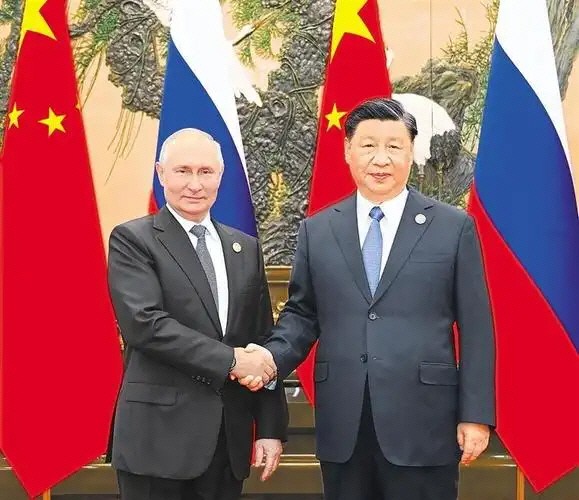 |
| Chinese President Xi Jinping and Russian President Vladimir Putin, who arrived late in the afternoon on May 19 for his 25th visit to China. During their summit on May 20, the two leaders are expected to declare a global multipolar order, challenging the U.S.-led unipolar system. / Xinhua News Agency |
Chinese President Xi Jinping and Russian President Vladimir Putin—marking his 25th visit to China—are set to hold a summit on May 20. It appears certain that the two leaders will declare a global multipolar order, effectively denying the reality of the United States as the world's sole superpower. Concurrently, the meeting is expected to clearly demonstrate to the international community that China’s "diplomatic rise (diplomatic prominence)" has now become an absolute reality.
According to Beijing sources well-versed in bilateral relations on May 19, the so-called bromance between President Xi and President Putin, who arrived in Beijing late this afternoon, is famously unparalleled worldwide. Little more needs to be said other than the fact that they have met face-to-face over 40 times, including formal summits, during the past 13 years since President Xi fully assumed power as China's top leader in 2013.
Therefore, synthesizing their leadership styles, recent international dynamics surrounding the U.S., China, and Russia, and foreign media reports, it is not difficult to anticipate that the atmosphere of the summit will strongly advocate for the end of the U.S.-led unipolar system and the arrival of a multipolar world order. It is equally predictable that the two leaders will shares a tacit understanding that a tripolar system among the U.S., China, and Russia—given their respective military and economic capabilities—has become an undeniable fixture.
Anticipating the detailed agendas up for discussion is likewise straightforward. Chief among them will be follow-up measures regarding issues addressed during the summit between U.S. President Donald Trump and President Xi held on May 14–15, alongside discussions on the wars in Ukraine and the Middle East. Additionally, securing a seamless supply of Russian crude oil and other energy resources for China is expected to be a key specific agenda item.
Furthermore, the two leaders are anticipated to discuss concrete ways to further strengthen strategic cooperation across nearly all sectors, spearheaded by politics, the economy, and security. This is underscored by President Putin's remarks in a video address released just ahead of his visit, in which he claimed, "Today, relations between our two countries have reached an unprecedented level. Our close strategic relationship plays a vital stabilizing role globally."
In particular, his expression of "actively supporting each other's national integration" is highly significant. Unlike President Trump, who intentionally took a ambivalent stance, President Putin made it clear that he firmly supports the "One China" principle. In this light, it is hardly surprising that foreign media outlets are churning out reports that Taiwan is exceptionally on edge regarding this summit.
The two leaders plan to widely publicize these positions and shared understandings to the outside world through a "Joint Declaration" to be released immediately after the summit—essentially sending a message for the United States and President Trump to heed. The upcoming summit between President Xi and President Putin will likely serve as a venue that clearly confirms the imminent arrival of a global multipolar order.
Most Read
-
1
Celltrion’s Omlyclo gains ground in major European..

-
2
Trump demands rates fall below 1% as Fed hikes for..

-
3
Trump makes $1 trillion bet ahead of midterm elect..

-
4
Iran resumes ballistic missile production, assembl..

-
5
Samsung Electronics, Mistral AI to jointly develop..

-
6
Trump warns countries not helping U.S. must pay re..

-
7
Apple launches first foldable, 1 million won prici..

PEOPLE






HEADLINE NEWS
- Trump to roll out ‘unprecedented welcome’ for Xi with B-2 bombers, F-22 fighters
- S. Korea, U.S., and Japan form united front on Taiwan and economic coercion..
- Trump administration moves to impose sweeping sanctions on International Cr..
- Xi to make state visit to U.S. Sept. 23-25, dispelling rumors over his heal..

-
Address : In-Young Bldg., 34, Uisadang-daero 1-gil, Yeongdeungpo-gu, Seoul
Copyright by ASIATODAY CO., LTD. All rights resereved