



Lee cites SK growth model amid petrochemical crisis
May 19, 2026, 10:44 am


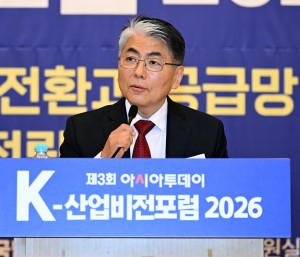 |
| Lee Chun-woo speaks during the third Asia Today K-Industry Vision Forum 2026 at the National Assembly Library in Seoul on May 19. /Song Eui-joo, Asia Today |
Lee Chun-woo said South Korea’s struggling petrochemical industry needs stronger entrepreneurship and bold long-term decisions to overcome the current crisis, citing SK Group as a leading example of successful transformation.
Speaking at the third Asia Today K-Industry Vision Forum 2026 held at the National Assembly Library in Seoul on May 19, Lee argued that the current downturn should be viewed not as a temporary slump but as a structural transformation that could create new opportunities depending on corporate strategy.
The forum, themed “Survival Strategies Between Business Transformation and Supply Chain Stability for the Crisis-Hit Petrochemical Industry,” was hosted by the office of Na Kyung-won and organized by Asia Today.
Lee pointed to China’s rapid expansion of petrochemical production capacity under its “Made in China 2025” initiative, global oversupply and post-pandemic demand shifts as major factors behind the industry’s current difficulties.
“In particular, China’s aggressive increase in ethylene production capacity has fundamentally changed the competitive landscape for Korea’s petrochemical industry,” he said.
Still, Lee stressed that crises do not necessarily lead to collapse for every company.
“Entrepreneurship is the ability to see what others cannot see,” he said. “Companies need the capability to anticipate the future and turn new ideas into reality.”
Lee highlighted SK Group’s business evolution as a representative example. According to his presentation, the former Sunkyong Group initially entered the refining business to stabilize raw material supplies for its textile operations. Later, it used the acquisition of Yukong to strengthen supply-chain stability while expanding into new businesses.
He said SK subsequently reinvested profits generated from refining operations into future growth sectors such as batteries, biotechnology and telecommunications, steadily broadening its business portfolio.
“The current crisis should not simply be treated as a matter of restructuring,” Lee said. “It should be recognized as a turning point for discovering new opportunities.”
He added that a long-term strategy balancing supply-chain stability with investment in future industries would be essential for survival and growth.
#Lee Chun-woo #University of Seoul #SK Group #petrochemical industry #entrepreneurship
Copyright by Asiatoday
Most Read
-
1
Kia Sportage outperforms Mazda CX-5 in German auto..

-
2
Houthis launch successive attacks on Saudi airport..

-
3
Saudi Arabia, Iran hold first diplomatic talks to..

-
4
U.S. deploys carrier, 10,000 more troops to Middle..

-
5
Saudi airport in Riyadh struck again, leaving at l..

-
6
Putin's ally visits China on the 8th ahead of APEC..

-
7
Chinese military support and training center opens..

PEOPLE






HEADLINE NEWS

-
Address : In-Young Bldg., 34, Uisadang-daero 1-gil, Yeongdeungpo-gu, Seoul
Copyright by ASIATODAY CO., LTD. All rights resereved