



Elon Musk loses legal battle with OpenAI as jury finds lawsuit was filed too late
May 19, 2026, 10:36 am


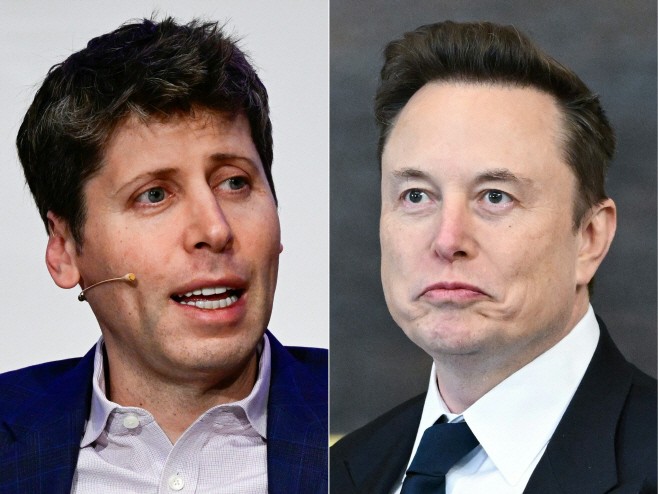 |
| This combination photo, created on February 11, 2025, shows OpenAI Chief Executive Officer (CEO) Sam Altman (left) in Berlin, Germany, on February 7, 2025 (local time), and Tesla CEO Elon Musk at the inauguration ceremony of U.S. President Donald Trump in Washington, D.C., on January 20, 2025. / AFP·Yonhap News |
Tesla CEO Elon Musk has lost a pivotal lawsuit against OpenAI and its CEO Sam Altman, with the court ruling that the claims were filed past the legally prescribed deadline.
A nine-member jury at the U.S. District Court for the Northern District of California in Oakland delivered a unanimous verdict on May 18 (local time) after less than two hours of deliberation, finding that the statute of limitations had expired. The jury concluded that Musk was already aware of the alleged infringements regarding the breach of charitable trust (three-year statute of limitations) and unjust enrichment (two-year statute of limitations) prior to August 2021. Judge Yvonne Gonzalez Rogers immediately accepted the verdict and dismissed the breach of trust and unjust enrichment claims.
The ruling clears a major legal uncertainty for OpenAI as it prepares for an initial public offering (IPO) at a projected valuation of $730 billion. However, Bloomberg reported that Musk immediately announced plans to appeal, and a separate antitrust phase of the same lawsuit remains active.
◇ Jury focus limited to statute of limitations; decision on core 'breach of non-profit mission' deferred
While the jury concluded that the statute of limitations had run out—finding that Musk was aware of OpenAI's transition toward a for-profit model before August 2021, well ahead of his formal complaint in August 2024—it did not rule on the merits of the case regarding whether OpenAI abandoned its original mission to develop artificial intelligence for the benefit of humanity, according to Bloomberg. Musk argued that he delayed filing the lawsuit because Altman had made reassuring statements to him, but the jury rejected this claim.
"There was substantial evidence to support the jury's conclusion," Judge Rogers explained. "Accordingly, I was prepared to dismiss it on the spot."
Musk’s legal team stated they retain the right to appeal. "This brings to mind pivotal moments in American history, like the Battle of Charleston and the Battle of Bunker Hill," Musk's attorney Marc Toberoff said, expressing a resolve to fight on. "Those were major losses for Americans at the time, but who won the war? This is far from over," Bloomberg reported.
However, Reuters noted that Judge Rogers implied the ruling would be difficult to overturn on appeal, as the expiration of a statute of limitations is a matter of factual finding by the jury.
Shubha Ghosh, a professor at Syracuse University College of Law, told the Wall Street Journal, "An appeal of this kind of verdict can be difficult." He pointed out, "It's a very rare circumstance where that can be appealed because it's generally a bright-line rule." He added, "What the jury found was that he took too long."
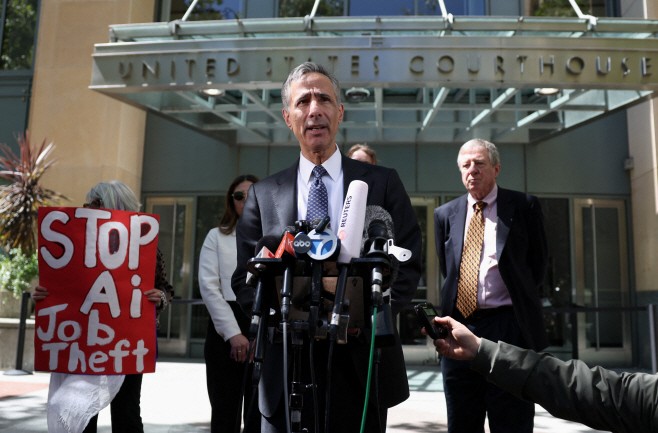 |
| William Savitt, an attorney representing OpenAI, holds a press conference outside the federal courthouse in Oakland, California, on May 18 (local time) regarding Tesla CEO Elon Musk's lawsuit over OpenAI's transition into a for-profit entity. / Reuters·Yonhap News |
◇ Musk claims charity was "stolen"; demands $134 billion return and $180 billion in damages based on $38 million contribution
Musk co-founded OpenAI as a non-profit organization in 2015 alongside Altman and others, contributing $38 million under the belief that the entity would remain dedicated to developing AI for the benefit of humanity. He filed the lawsuit in 2024, alleging that Altman and President Greg Brockman reneged on that promise by transitioning it into a for-profit enterprise, causing him financial and moral harm.
Musk’s legal team claimed that Altman and Brockman "stole a charity" and demanded their ouster, a reversal of last year's for-profit restructuring, the return of $134 billion in accumulated profits to the OpenAI foundation, and more than $180 billion in damages.
Immediately following the verdict, Musk took to his social media platform X (formerly Twitter) to condemn the ruling as a "horrible precedent." He criticized the court, stating, "The judge used the jury as a fig leaf," and added, "The judge just issued a free license to plunder a charity, as long as you can keep the plundering quiet for a few years."
During closing arguments, Musk's attorney Steven Molo launched a sharp attack against Altman, stating, "Five witnesses called him a perjurer during this trial."
Bloomberg pointed out that this defeat coincides with an accumulation of recent legal risks for Musk. Tesla was hit with a $243 million verdict last August in a lawsuit involving a fatal car crash, and Musk lost a separate lawsuit brought by Twitter shareholders in March, leaving him facing a potential damages liability of up to $2.6 billion.
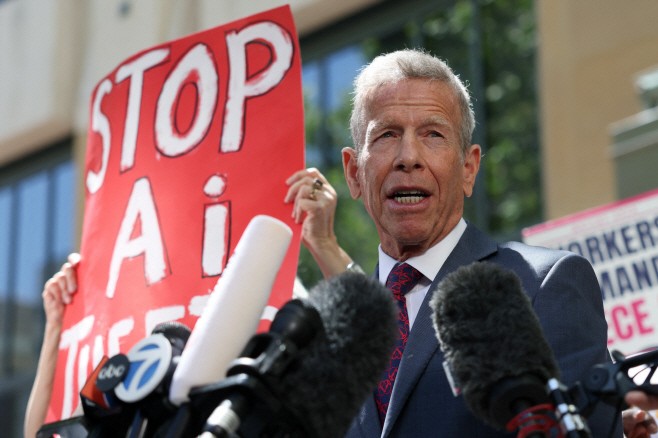 |
| Marc Toberoff, an attorney representing Tesla CEO Elon Musk, holds a press conference outside the federal courthouse in Oakland, California, on May 18 (local time) regarding Musk's lawsuit over OpenAI's transition into a for-profit entity. / Reuters·Yonhap News |
◇ OpenAI counters, calling suit a "hypocritical attempt to disrupt a competitor"; text messages and emails since 2017 prove Musk's support for for-profit transition
OpenAI hit back, stating, "The jury's verdict confirms that this lawsuit was a hypocritical attempt by a hypocrite to disrupt a competitor." The entity emphasized, "OpenAI is an organization centered around its non-profit mission, to which we have been and will remain faithful." The Wall Street Journal reported that William Savitt, an attorney representing OpenAI, remarked, "It turns out that the only thing Musk can do to succeed in AI is come to court."
The New York Times reported that OpenAI countered Musk by presenting hundreds of his private text messages, emails, and internal documents as evidence during the three-week trial. These materials demonstrated that Musk had not only been aware of the potential transition to a for-profit structure since 2017 but had also supported it, even attempting to secure control over the entity himself.
During his testimony, Altman stated that Musk had at one point proposed he should take a 90% stake in the for-profit transition. Musk countered this, claiming he only desired a majority stake initially to ensure the project maintained the right direction.
Bloomberg reported that President Brockman took a direct aim at Musk’s understanding of AI technology during his courtroom testimony, stating, "He knows rockets, and he knows electric cars. He didn't know AI, and I don't think he knows AI today."
The Wall Street Journal also reported that portions of Brockman’s personal diary were disclosed during the trial, including a line that read, "What will bring me to $1 billion financially?"
According to Bloomberg, OpenAI argued that its transition from a non-profit charity to a commercial enterprise was a necessary decision to secure the massive funding required to fulfill its mission of developing artificial intelligence (AGI) that benefits humanity. The entity maintained that its founding mission remains intact, as the public-benefit corporation established last year continues to be controlled by the OpenAI foundation.
◇ Big Tech stakes revealed in court: Brockman at $30 billion, MS up to $135 billion, Altman holds 0% direct stake
Bloomberg reported that the jury's verdict applied equally to Musk's claims against Microsoft, whom he accused of aiding and abetting OpenAI's breach of charitable trust.
Musk claimed that Microsoft facilitated the for-profit transition by investing $13 billion in OpenAI between 2019 and 2023. Microsoft released a statement welcoming the decision, saying, "The facts and timeline of this case have been clear for a long time," and adding, "We welcome the jury's decision to dismiss the claims as time-barred."
Bloomberg reported that Microsoft CEO Satya Nadella testified that Microsoft invested with a target return of $92 billion, and the value of its holding reached $135 billion as of October last year.
Altman testified that he does not hold any direct equity in OpenAI, but instead owns stakes in companies that maintain business relationships with OpenAI, according to Bloomberg.
The trial also revealed that Shivon Zilis, the mother of four of Musk's children and a former OpenAI board member, had been romantically involved with Musk much earlier than previously known, and had continued to relay internal OpenAI information to him even after his departure from the board.
◇ OpenAI resolves one major IPO uncertainty; antitrust and trade secret claims proceed separately
The Wall Street Journal assessed that the ruling resolves a major legal uncertainty for OpenAI as it pursues its target IPO this year. Over the past year, OpenAI has navigated a renegotiation of its once-strained partnership with Microsoft, secured regulatory approval for its for-profit restructuring, managed the rise of Anthropic, and closed a $122 billion funding round—the largest in Silicon Valley history.
However, the legal battle with Musk is not yet over. Musk's lawsuit includes antitrust claims alleging that OpenAI and Microsoft formed a monopoly through their partnership and pressured investors not to fund competing AI startups, thereby harming rivals like xAI. Judge Rogers separated these antitrust claims into a distinct phase. Separately, Musk's xAI is pursuing trade secret misappropriation and antitrust lawsuits against OpenAI.
The Wall Street Journal reported that during a consultation with the legal teams immediately after the verdict, Judge Rogers expressed skepticism regarding the remaining antitrust claims, stating, "It is not clear that it is actually a good claim." She added, "Competition law is not there to protect specific individuals; it is there to protect competition, and there is plenty of competition in this industry."
The New York Times previously reported that Judge Rogers had signaled a low probability of the second-phase trial moving forward.
Most Read
-
1
Celltrion’s Omlyclo gains ground in major European..

-
2
Trump demands rates fall below 1% as Fed hikes for..

-
3
Trump makes $1 trillion bet ahead of midterm elect..

-
4
Iran resumes ballistic missile production, assembl..

-
5
Samsung Electronics, Mistral AI to jointly develop..

-
6
Trump warns countries not helping U.S. must pay re..

-
7
Apple launches first foldable, 1 million won prici..

PEOPLE





HEADLINE NEWS
- Trump to roll out ‘unprecedented welcome’ for Xi with B-2 bombers, F-22 fighters
- S. Korea, U.S., and Japan form united front on Taiwan and economic coercion..
- Trump administration moves to impose sweeping sanctions on International Cr..
- Xi to make state visit to U.S. Sept. 23-25, dispelling rumors over his heal..

-
Address : In-Young Bldg., 34, Uisadang-daero 1-gil, Yeongdeungpo-gu, Seoul
Copyright by ASIATODAY CO., LTD. All rights resereved