



T’way Air returns to profit on strong travel demand
May 13, 2026, 09:27 am


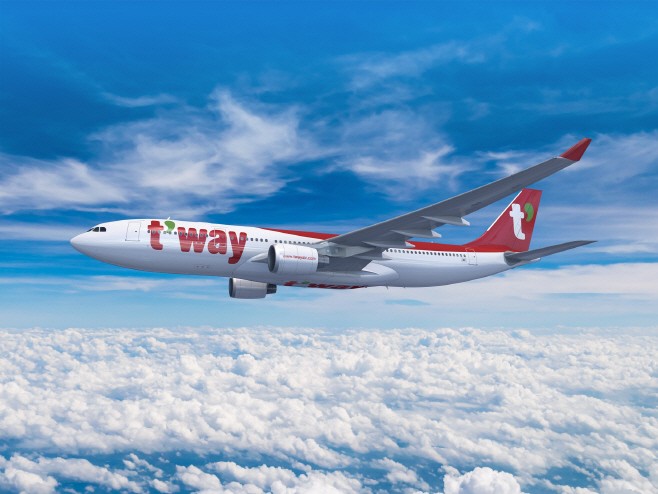 |
| A T’way Air aircraft. / T’way Air |
T'way Air posted a strong turnaround in the first quarter of 2026, driven by improved route efficiency and fleet modernization strategies that aligned with recovering travel demand.
According to regulatory filings released on May 13, the South Korean low-cost carrier reported standalone revenue of 612.2 billion won ($447 million) for the January-March period, up about 37% from a year earlier. Operating profit came in at 19.9 billion won, marking the airline’s first quarterly profit in eight quarters.
The company attributed the earnings recovery to flexible supply strategies tailored to route-specific demand trends. Stable passenger demand continued on domestic, Japan, and Taiwan routes, while demand also expanded on medium- and long-haul services to Europe, Australia, and North America.
As a result, the airline achieved an average load factor of 90% across its network during the quarter.
Domestic and Japan routes posted load factors of 95%, followed by Taiwan at 94%, Southeast Asia at 93%, and Europe at 90%. Long-haul routes to Sydney and Canada also recorded relatively stable performance with load factors of 85% and 80%, respectively.
Fleet modernization efforts are also accelerating.
T’way Air currently operates 49 aircraft and introduced two next-generation Boeing 737 MAX 8 jets during the first quarter. The airline also plans to gradually introduce the Airbus A330-900neo later this year.
The A330-900neo is considered a next-generation eco-friendly aircraft with improved fuel efficiency and lower carbon emissions compared with older models. The company expects the aircraft to strengthen competitiveness on medium- and long-haul routes while improving overall operating efficiency.
Cargo operations also continued to grow. T’way Air handled approximately 9,000 tons of cargo during the first quarter and expects transport capacity to expand further as additional wide-body aircraft are introduced.
The airline is simultaneously investing in maintenance capabilities.
T’way Air recently signed an agreement with Incheon International Airport Corporation to build its own aircraft maintenance hangar within the airport’s advanced aviation complex. Construction is expected to begin within the year.
The company aims to reduce reliance on overseas maintenance services while strengthening in-house maintenance competitiveness. In the long term, it is also considering expanding into external maintenance, repair, and overhaul (MRO) businesses.
Meanwhile, shareholders recently approved a corporate name change from T’way Air to Trinity Air. The new brand name will officially take effect after approval procedures with domestic and overseas aviation authorities are completed.
A company official said operational efficiency improvements and stronger fleet competitiveness played a key role in the earnings rebound, adding that the airline plans to further strengthen both flight safety systems and service competitiveness.
#T’way Air #Trinity Air #airline earnings #Boeing 737-8 #Airbus A330-900NEO
Copyright by Asiatoday
Most Read
-
1
Kia Sportage outperforms Mazda CX-5 in German auto..

-
2
Houthis launch successive attacks on Saudi airport..

-
3
Saudi Arabia, Iran hold first diplomatic talks to..

-
4
U.S. deploys carrier, 10,000 more troops to Middle..

-
5
Saudi airport in Riyadh struck again, leaving at l..

-
6
Putin's ally visits China on the 8th ahead of APEC..

-
7
Chinese military support and training center opens..

PEOPLE






HEADLINE NEWS

-
Address : In-Young Bldg., 34, Uisadang-daero 1-gil, Yeongdeungpo-gu, Seoul
Copyright by ASIATODAY CO., LTD. All rights resereved