



Seoul braces for supply chain risks ahead of US-China summit
May 13, 2026, 09:26 am


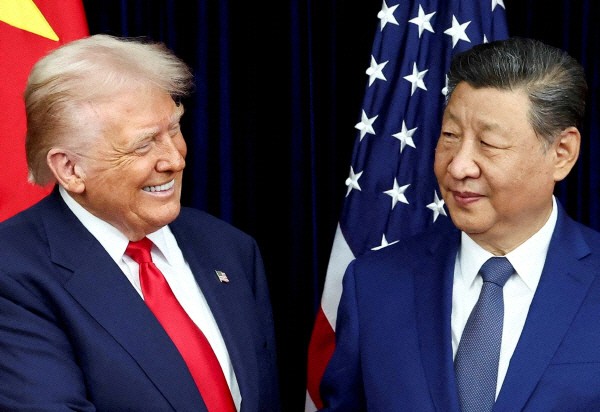 |
| U.S. President Donald Trump and Chinese President Xi Jinping hold a bilateral summit on the sidelines of the APEC summit at Gimhae International Airport in Busan in October last year. / Reuters-Yonhap |
South Korea’s presidential office is closely monitoring risks surrounding the Strait of Hormuz and semiconductor supply chains ahead of a summit between the United States and China, as the outcome could have major implications for energy prices, exports, and industrial stability.
According to diplomatic sources on May 12, Donald Trump and Xi Jinping are scheduled to hold summit talks in Beijing on May 14.
Key agenda items are expected to include the Iran crisis, tariff and trade disputes, rare earth supply chains, artificial intelligence and semiconductor controls, and Taiwan-related issues.
The South Korean government is paying particular attention to developments surrounding Iran and the stability of the Strait of Hormuz. Washington is reportedly expected to pressure Beijing to play a greater role in stabilizing the Middle East by leveraging China’s purchases of Iranian crude oil and its influence over Tehran.
President Lee Jae-myung has recently emphasized price stability and the management of oil and critical material supply chains as key pillars of his emergency economic response strategy.
Concerns have also intensified following the recent attack on the South Korean cargo vessel HMM Namu near the Strait of Hormuz. Although the incident itself may not directly appear on the summit agenda, analysts say the United States could raise the issue of China’s influence over Iran and maritime stability in the region during the talks.
Rare earth materials and semiconductor supply chains are also emerging as critical variables.
China holds a dominant position not only in rare earth mining but also in refining and processing, meaning any export restrictions could affect semiconductors, batteries, electric vehicles, and defense industries worldwide. Escalating tensions between Washington and Beijing over AI and semiconductor controls could also place additional pressure on South Korea’s semiconductor sector, one of the country’s key economic drivers.
Trade and tariff policies are another major focus for Seoul as the government assesses the potential impact on exports and domestic inflation.
Political observers say the outcome of the U.S.-China summit could become a major turning point for South Korea’s management of economic and industrial risks ahead of the June 3 local elections, with inflation, exports, and supply chain stability expected to influence public sentiment.
Ahead of the summit, senior officials from both countries are also scheduled to meet President Lee in Seoul. The presidential office announced that Lee will meet Chinese Vice Premier He Lifeng at 9:30 a.m. and U.S. Treasury Secretary Scott Bessent at 10:30 a.m. on May 13.
The meetings are widely viewed as part of last-minute coordination efforts between Washington and Beijing ahead of the leaders’ summit.
#United States #China #Donald Trump #Xi Jinping #Hormuz Strait
Copyright by Asiatoday
Most Read
-
1
Celltrion’s Omlyclo gains ground in major European..

-
2
Trump demands rates fall below 1% as Fed hikes for..

-
3
Trump makes $1 trillion bet ahead of midterm elect..

-
4
Iran resumes ballistic missile production, assembl..

-
5
Samsung Electronics, Mistral AI to jointly develop..

-
6
Trump warns countries not helping U.S. must pay re..

-
7
Apple launches first foldable, 1 million won prici..

PEOPLE






HEADLINE NEWS
- Trump to roll out ‘unprecedented welcome’ for Xi with B-2 bombers, F-22 fighters
- S. Korea, U.S., and Japan form united front on Taiwan and economic coercion..
- Trump administration moves to impose sweeping sanctions on International Cr..
- Xi to make state visit to U.S. Sept. 23-25, dispelling rumors over his heal..

-
Address : In-Young Bldg., 34, Uisadang-daero 1-gil, Yeongdeungpo-gu, Seoul
Copyright by ASIATODAY CO., LTD. All rights resereved