



Boston Dynamics exits raise concerns over Hyundai robot push
May 13, 2026, 08:28 am


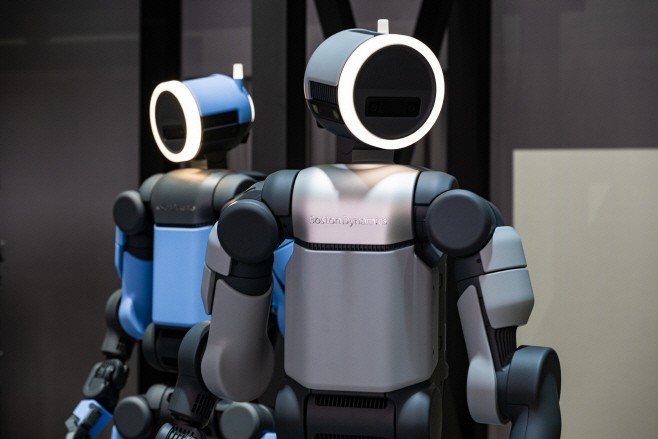 |
| Boston Dynamics’ humanoid robot Atlas. / Hyundai Motor Group |
A series of executive departures at Boston Dynamics has sparked concerns over possible internal tensions with parent company Hyundai Motor Group as the companies accelerate efforts to commercialize humanoid robots.
According to the robotics industry on May 12, several top executives at Boston Dynamics left the company during the first half of this year, including longtime CEO Robert Playter, Vice President Scott Kuindersma, the chief technology officer (CTO), and the chief strategy officer (CSO).
The departing executives were key figures behind the development of Atlas, Boston Dynamics’ flagship humanoid robot, and many had been with the company since its early days.
Their exits come at a critical moment as Hyundai Motor Group pushes toward commercialization and mass production of Atlas. Industry observers speculate that differences between Hyundai’s manufacturing-focused business culture and Boston Dynamics’ research-driven DNA may have surfaced as internal tensions.
Hyundai Motor Group has already outlined an ambitious roadmap for robotics. The company plans to deploy Atlas robots capable of repetitive industrial tasks by 2028 and introduce advanced general-purpose humanoid robots by 2030. It is also pursuing plans to build a robot factory capable of producing 30,000 units annually by 2028.
Competition in the humanoid robot market has intensified rapidly.
Elon Musk’s Tesla has announced plans to deploy its Optimus humanoid robots in its own factories soon, while Figure AI is reportedly already capable of producing one robot per hour.
As rivals aggressively move toward large-scale production, some analysts believe pressure from Boston Dynamics’ board may have contributed to the executive departures.
Jung Tae-kyung, a robotics engineering professor at Hallym University, said companies with proprietary AI operating systems such as Tesla are rapidly advancing humanoid commercialization, although Atlas may still need more time before full-scale deployment.
“Humanoid robots are likely to enter production sites within three to five years,” Jung said. “To achieve that, companies will need customized manufacturing data that AI systems can learn from across different industrial processes.”
Since Hyundai Motor Group acquired Boston Dynamics, the company’s core mission has become increasingly clear: transforming Atlas into a commercially viable industrial worker capable of generating real revenue.
The pressure is growing further as Boston Dynamics is reportedly considering an initial public offering (IPO) this year. The company must now prove not only its technological superiority but also its ability to execute quickly in a competitive market.
Industry attention is now focused on who will become the next CEO.
Hyundai Motor Group previously stated during its first-quarter earnings call that the board is leading the selection process for a new chief executive. Market watchers expect the new leader to possess both deep technological expertise and strong manufacturing capabilities aligned with Hyundai’s industrial DNA.
Lee Hang-gu, a researcher at the Korea Automobile Research Institute, said Tesla and Chinese robotics firms are already moving toward mass production while Korea remains in the early stages.
“The most important challenge is achieving highly sophisticated hand movements,” Lee said. “That should be the primary focus going forward.”
#Hyundai Motor Group #Boston Dynamics #Atlas #humanoid robot #robotics
Copyright by Asiatoday
Most Read
-
1
Kia Sportage outperforms Mazda CX-5 in German auto..

-
2
Houthis launch successive attacks on Saudi airport..

-
3
Saudi Arabia, Iran hold first diplomatic talks to..

-
4
U.S. deploys carrier, 10,000 more troops to Middle..

-
5
Saudi airport in Riyadh struck again, leaving at l..

-
6
Putin's ally visits China on the 8th ahead of APEC..

-
7
Chinese military support and training center opens..

PEOPLE






HEADLINE NEWS

-
Address : In-Young Bldg., 34, Uisadang-daero 1-gil, Yeongdeungpo-gu, Seoul
Copyright by ASIATODAY CO., LTD. All rights resereved