



Kim Yong-beom calls for AI profits to be shared nationwide
May 12, 2026, 12:46 pm


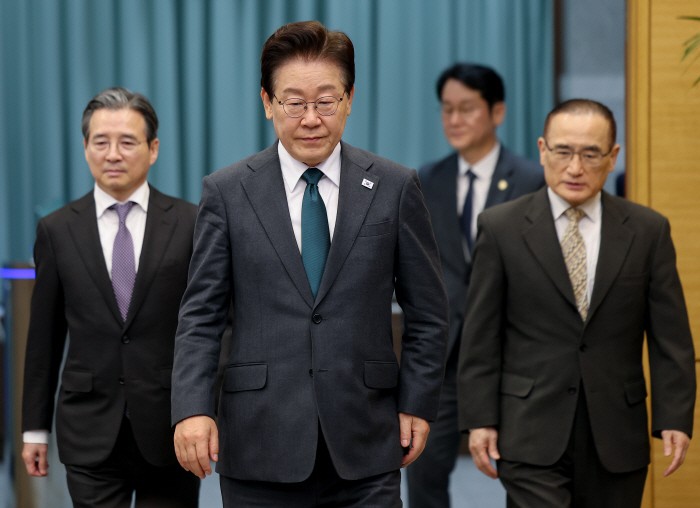 |
| Lee Jae-myung enters a senior presidential aides meeting at the presidential office on May 7. From left are Kim Yong-beom, presidential chief policy secretary, President Lee, protocol secretary Kwon Hyuk-ki, and national security adviser Wi Sung-lac. /Yonhap |
South Korea’s presidential office is expected to begin reviewing ways to share excess profits generated by the semiconductor supercycle with the broader public, as discussions surrounding AI-era wealth redistribution gain momentum.
The debate has drawn attention because the concept aligns closely with the “universal basic income” philosophy long advocated by Lee Jae-myung, particularly as artificial intelligence-driven demand fuels record earnings for semiconductor companies.
On Sunday evening, presidential chief policy secretary Kim Yong-beom posted a message on Facebook titled “A Different Kind of Nation: Korea’s Long-Term Strategy in the AI Era,” in which he proposed the concept of a “national dividend” as a way to socially distribute excess profits generated in the AI age.
Kim wrote that while South Korea is well-positioned as a comprehensive supplier across the AI infrastructure supply chain, wealth created through AI infrastructure is likely to become concentrated among specific groups.
He argued that the key challenge in the AI era is not merely economic growth, but how to stabilize and distribute excess profits socially.
“Excess profits in the AI era are inherently concentrated,” Kim wrote. “Shareholders of memory chip companies, core engineers, and owners of metropolitan-area assets — those who already have access to productive assets — are highly likely to receive enormous benefits through market mechanisms. Even if the country becomes wealthier, the distribution of that wealth does not automatically spread.”
Kim emphasized that the benefits of the AI infrastructure era were not created by a handful of companies alone.
“They are built on the industrial foundation accumulated by the entire population over the past half-century,” he said. “Therefore, part of those gains should be structurally returned to all citizens. That is the legitimacy and principle behind the design.”
Kim also referred to a recent meeting between President Lee and Demis Hassabis, chief executive of Google DeepMind, held late last month.
During the meeting, Hassabis reportedly suggested that both governments and corporations would need “new economic models” in the AI era.
Lee responded by noting that he had advocated universal basic income for more than two decades and questioned whether the AI era itself strengthened the case for such policies. Hassabis reportedly agreed on the need for basic income, while also suggesting that governments provide essential services such as housing, education, transportation, and healthcare while incorporating market principles into the system.
A presidential office official downplayed speculation of immediate policy action, saying discussions on a “national dividend” had not formally begun. Kim also described his Facebook post as his “personal thoughts.”
Still, some observers view the government’s recent 25 trillion won supplementary budget package and its energy price relief payments of up to 600,000 won per citizen as being connected to the broader philosophy of basic income and national dividends.
The supplementary budget was largely funded by increased tax revenue generated from record earnings at semiconductor companies such as Samsung Electronics and SK hynix during the global semiconductor supercycle.
Another presidential office official said discussions on a basic income society in the AI era were ultimately “a path that must eventually be taken,” noting that the idea remains one of President Lee’s campaign pledges.
#Kim Yong-beom #AI dividend #universal basic income #Samsung Electronics #SK hynix
Copyright by Asiatoday
Most Read
-
1
Trump demands rates fall below 1% as Fed hikes for..

-
2
Chinese e-commerce giants AliExpress, Temu and She..

-
3
Trump warns countries not helping U.S. must pay re..

-
4
Turkish Airlines named main club partner of Liverp..

-
5
China expels No. 2 military official Zhang Youxia..

-
6
Celltrion seeks rheumatoid arthritis indication ex..

-
7
Houthi rebels release video claiming downing of Sa..

PEOPLE






-
Address : In-Young Bldg., 34, Uisadang-daero 1-gil, Yeongdeungpo-gu, Seoul
Copyright by ASIATODAY CO., LTD. All rights resereved