



FSS tightens market oversight as KOSPI tops 7800
May 12, 2026, 08:50 am


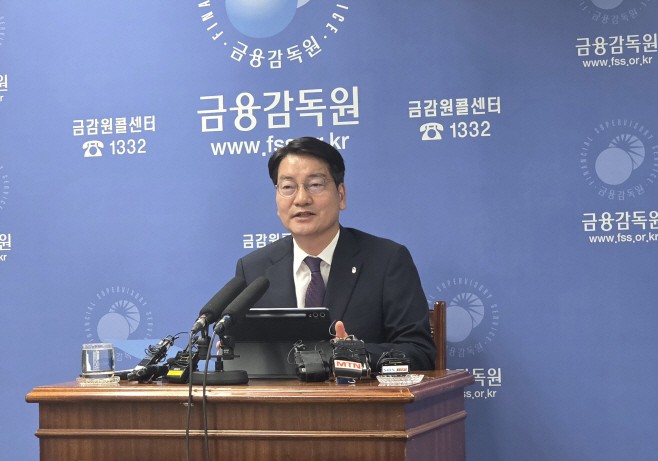 |
| Hwang Sun-oh, Senior Deputy Governor for Capital Markets and Accounting at South Korea’s Financial Supervisory Service (FSS), speaks during a monthly briefing at the FSS headquarters in Yeouido, Seoul, on May 11. / Reporter Park Joo-yeon |
South Korea’s financial regulator said it will strengthen market risk management as the benchmark KOSPI index surpassed the 7,800-point mark for the first time, amid concerns over rising volatility and speculative trading activity.
Speaking at a capital markets briefing on May 11, Hwang Sun-oh, Senior Deputy Governor for Capital Markets and Accounting at the Financial Supervisory Service (FSS), said authorities are closely monitoring risks linked to the launch of single-stock leveraged and inverse exchange-traded funds (ETFs) tied to Samsung Electronics and SK hynix scheduled for May 22.
“There is a possibility of concentrated trading by investors, which could lead to greater market volatility,” Hwang said.
He added, however, that similar products have already been introduced in major overseas markets and that the decision also reflected the need for consistency with global regulatory standards. The FSS plans to provide investor education before the products launch and continue monitoring trading trends afterward.
The regulator also expressed concern over a recent surge in short-term trading activity in the ETF market. According to the FSS, the average daily turnover rate for ETFs reached a record 21.58% in April this year, while some futures inverse ETFs posted turnover rates as high as 70%.
Hwang urged investors to carefully consider trading costs and loss risks, stressing the importance of fostering a long-term investment culture.
The FSS also announced plans to strengthen accounting oversight, warning that tougher delisting requirements could increase incentives for companies to engage in accounting fraud to maintain listings.
“We are monitoring possible attempts to inflate sales or manage market capitalization,” Hwang said. “We also plan to expand the scope of companies subject to accounting reviews.”
Under a new mid- to long-term roadmap, the FSS plans to shorten accounting audit cycles for listed companies from the current average of 20 years to 10 years for KOSPI-listed firms and five years for KOSDAQ-listed firms. Companies included in the KOSPI 200 index will be subject to 10-year audit cycles first.
Separately, Hwang commented on Mirae Asset Securities’ reported efforts to sell SpaceX-related investment products in Korea, saying the firm appears willing to proceed but that no concrete sales structure has yet been finalized.
“If excessive promotion takes place before details are finalized, there could be concerns over regulatory violations, so we have asked the company to refrain from over-publicizing the matter,” he said.
#KOSPI #Financial Supervisory Service #FSS #Hwang Sun-oh #ETF
Copyright by Asiatoday
Most Read
-
1
Celltrion’s Omlyclo gains ground in major European..

-
2
Trump demands rates fall below 1% as Fed hikes for..

-
3
Trump makes $1 trillion bet ahead of midterm elect..

-
4
Iran resumes ballistic missile production, assembl..

-
5
Trump warns countries not helping U.S. must pay re..

-
6
Apple launches first foldable, 1 million won prici..

-
7
Turkish Airlines named main club partner of Liverp..

PEOPLE







-
Address : In-Young Bldg., 34, Uisadang-daero 1-gil, Yeongdeungpo-gu, Seoul
Copyright by ASIATODAY CO., LTD. All rights resereved