



Hormuz oil shock could push Korea inflation up 1.6%p
May 11, 2026, 12:03 pm


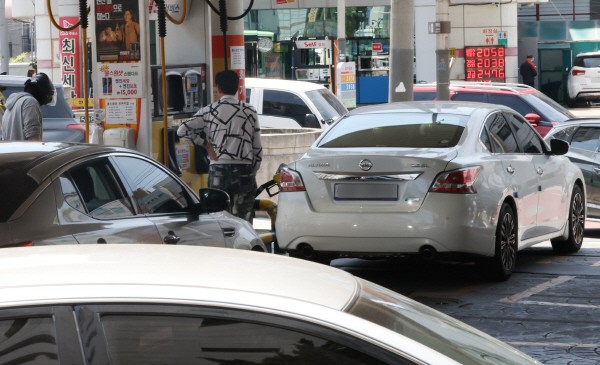 |
| Vehicles line up to refuel at a budget gas station in Seoul on May 10, while a nearby regular gas station with gasoline prices 79 won higher per liter remains relatively empty. /Yonhap |
A surge in global oil prices triggered by disruptions in the Strait of Hormuz could raise South Korea’s consumer inflation by as much as 1.6 percentage points this year, according to a report released Sunday by the Korea Development Institute
.
In its report titled “The Impact of Recent International Oil Price Increases on Consumer Prices,” the state-run think tank said oil price shocks caused by transportation disruptions have a much stronger inflationary effect than ordinary supply-and-demand-driven increases.
KDI said the latest spike in oil prices was driven primarily by uncertainty surrounding crude oil transportation caused by the Middle East conflict, rather than by economic recovery or production cuts by oil-exporting countries.
The report noted that Dubai crude prices temporarily surged to as high as $170 per barrel after Iran’s blockade of the Strait of Hormuz effectively disrupted oil transportation routes.
South Korea is particularly vulnerable because around 70 percent of its crude oil imports come from the Middle East, the institute said.
KDI based its analysis on an “energy transportation uncertainty index” calculated using the frequency of news reports related to energy supply chains, geopolitical risks and logistics disruptions. The index reportedly climbed to 8.5 times its historical average in March, approaching levels seen during the oil shocks of the 1970s.
According to the analysis, a 10 percent increase in international oil prices caused by transportation uncertainty raises South Korea’s consumer inflation by 0.20 percentage points, nearly double the 0.11 percentage-point effect from typical supply-and-demand-related oil price increases.
The institute also found that transportation-related oil shocks affect core inflation, which excludes volatile items such as energy and agricultural products.
While ordinary oil price increases had limited influence on core inflation, transportation uncertainty-driven increases raised core inflation by an estimated 0.10 percentage points, suggesting the impact could spread across industrial goods and services throughout the economy.
KDI presented several inflation scenarios based on future oil price trends.
Under its baseline scenario, where crude oil prices rise to around $100 per barrel in the second quarter before gradually easing to the $80-$90 range in the second half of the year, inflation would increase by 1.2 percentage points this year.
In a prolonged high-price scenario, where oil prices remain around $105 per barrel throughout the year, consumer inflation could rise by 1.6 percentage points this year and by 1.8 percentage points next year.
If oil prices stabilize quickly, inflationary pressure is expected to ease significantly beginning next year, the report said.
KDI added that government measures such as fuel tax cuts and the petroleum price ceiling system have helped partially offset inflationary pressure.
The institute estimated that the petroleum price ceiling system reduced inflation by as much as 0.8 percentage points as of March, while expanded fuel tax cuts in April lowered inflation by an additional 0.2 percentage points.
#KDI #oil prices #Strait of Hormuz #inflation #South Korea
Copyright by Asiatoday
Most Read
-
1
Kia Sportage outperforms Mazda CX-5 in German auto..

-
2
Houthis launch successive attacks on Saudi airport..

-
3
Saudi Arabia, Iran hold first diplomatic talks to..

-
4
U.S. deploys carrier, 10,000 more troops to Middle..

-
5
Saudi airport in Riyadh struck again, leaving at l..

-
6
Putin's ally visits China on the 8th ahead of APEC..

-
7
Chinese military support and training center opens..

PEOPLE






HEADLINE NEWS

-
Address : In-Young Bldg., 34, Uisadang-daero 1-gil, Yeongdeungpo-gu, Seoul
Copyright by ASIATODAY CO., LTD. All rights resereved