



USFK chief sets 2029 OPCON condition target, timing gap with Korea
Apr 23, 2026, 08:54 am


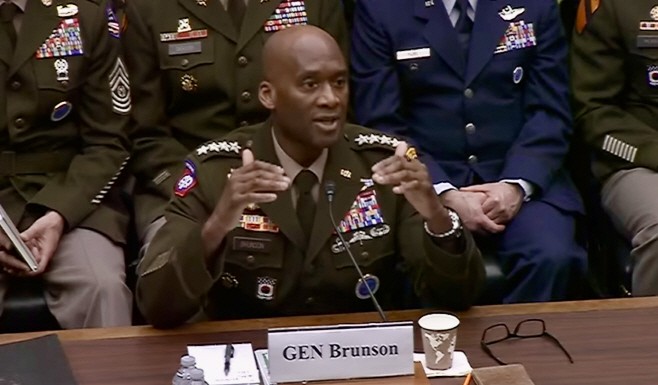 |
| Xavier Brunson, commander of United States Forces Korea, testifies at a House Armed Services Committee hearing at the U.S. Capitol in Washington, D.C., on April 22. / House Armed Services Committee livestream capture |
Xavier Brunson, commander of United States Forces Korea, said the target for meeting conditions required to transfer wartime operational control (OPCON) is the first quarter of 2029, highlighting a timing gap with South Korea’s goal of 2028.
Speaking at a hearing of the House Armed Services Committee in Washington on April 22, Brunson said a roadmap had been submitted to the U.S. Department of Defense to meet the required conditions by the second quarter of fiscal year 2029.
He emphasized that the transition remains strictly conditions-based, reiterating, “Accelerated COTP is not time-based,” and stressing that fulfilling required capabilities is a prerequisite for OPCON transfer.
The timeline does not represent a fixed date for transfer itself, but rather a target for achieving the necessary conditions. It nonetheless differs from South Korea’s potential goal of 2028, which may be discussed at the upcoming Security Consultative Meeting.
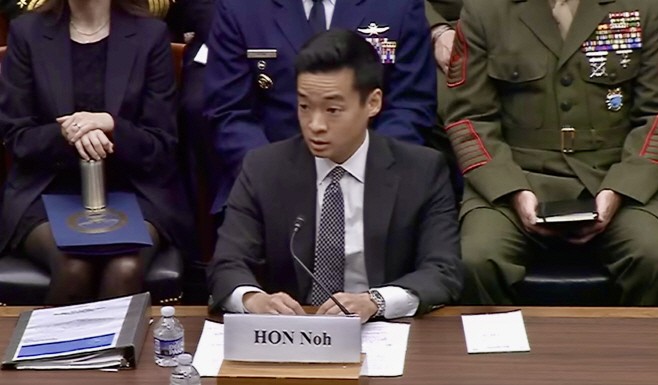 |
| John No testifies at a House Armed Services Committee hearing at the U.S. Capitol in Washington, D.C., on April 22. / House Armed Services Committee livestream capture |
U.S. lawmakers from both parties underscored that OPCON cannot be transferred until all conditions are met. Committee Chairman Mike Rogers said there is no need to rush the process before those conditions are satisfied.
Brunson also rejected the idea of withdrawing U.S. forces from Korea, saying such a move would not constitute sound military advice to leadership.
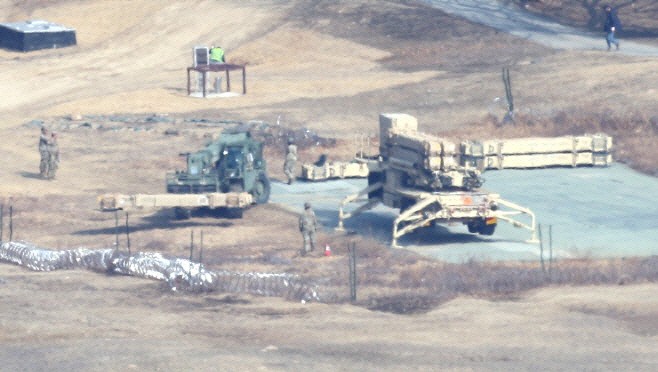 |
| U.S. forces dismantle an air defense launcher at a THAAD base in Seongju, North Gyeongsang Province, on March 5. / Yonhap |
On South Korea’s strategic role, he noted the importance of having the capability to impose costs in both the West Sea and East Sea, using terminology aligned with Seoul’s official stance.
He added that alongside OPCON transition, the role of U.S. forces may evolve to provide “critical but more limited” support on North Korea-related missions while expanding their operational outlook westward.
In written testimony, Brunson highlighted the Korean Peninsula’s position within the “First Island Chain,” noting its strategic advantage for projecting power across the Indo-Pacific region.
He also praised South Korea as a top-tier partner, citing its military strength—ranked among the world’s top forces—and its increasing defense spending, which is expected to reach 3.5% of GDP.
A Pentagon official added that South Korea has committed to expanding defense spending and purchasing $25 billion worth of U.S. military equipment by 2030, while assuming greater responsibility for deterring North Korea.
#Xavier Brunson #OPCON transfer #USFK #South Korea military #defense policy
Copyright by Asiatoday
Most Read
-
1
Trump shares map on social media labeling Strait o..

-
2
Kia Sportage outperforms Mazda CX-5 in German auto..

-
3
Houthis launch successive attacks on Saudi airport..

-
4
U.S. deploys carrier, 10,000 more troops to Middle..

-
5
Trump rejects Iran's offer to open Strait of Hormu..

-
6
N. Korea conducts first swarm attack drill with dr..

-
7
U.S.-China summit falls short on substance as Trum..

PEOPLE






HEADLINE NEWS
- Seoul dismisses Ukraine's claim of 'S. Korean support for Russia' as "inaccurate and inappropriate"
- S. Korea, Japan race to develop nuclear-powered submarines
- Henri Kagan, Kenso Soai win Nobel Prize in Chemistry for uncovering how mol..
- Vance says Alaska LNG cooperation will move forward with Seoul's current or..

-
Address : In-Young Bldg., 34, Uisadang-daero 1-gil, Yeongdeungpo-gu, Seoul
Copyright by ASIATODAY CO., LTD. All rights resereved