



US-Iran ceasefire deadline nears amid stalled talks
Apr 21, 2026, 08:56 am


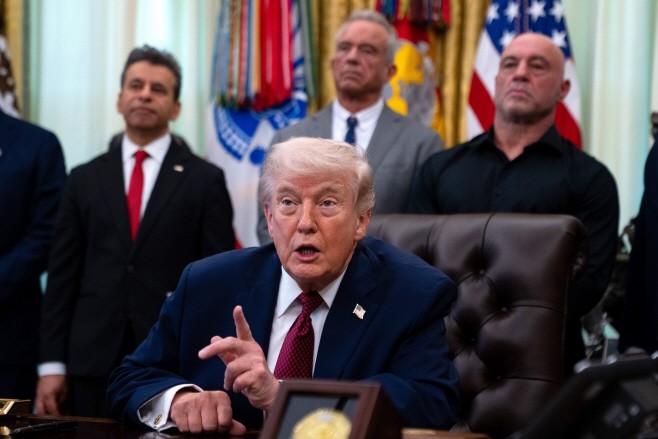 |
| US President Donald Trump speaks during an executive order signing ceremony in the Oval Office at the White House in Washington, D.C. / EPA-Yonhap |
The deadline for ceasefire negotiations between the United States and Iran is approaching, but prospects for a lasting agreement remain uncertain.
With a two-week truce set to expire on April 22 evening (U.S. Eastern Time), Donald Trump has warned of renewed military action if no agreement is reached, while Iran has yet to decide whether it will participate in talks amid internal divisions.
Trump has maintained a maritime blockade on Iran, reportedly costing the country about $500 million per day, and signaled that the pressure would continue unless a deal is signed. Iran, however, has rejected what it sees as U.S. coercion and is demanding a change in Washington’s stance before committing to negotiations.
Pakistan has stepped up efforts to mediate, using the potential lifting of the blockade as leverage. However, significant differences between the two sides remain, leaving the outcome of the negotiations unclear.
Trump warns of bombing, maintains pressure
In a phone interview with Bloomberg on April 20, Trump confirmed that the ceasefire deadline would be “Wednesday evening, Washington time,” and said the chances of an extension were “very small.”
The extension effectively adds one day to the original timeline, which had been widely understood to end on April 21, according to The New York Times.
In an interview with PBS, Trump warned that if the deadline passes without an agreement, “many bombs will fall,” adding that the maritime blockade against Iran would remain in place “until a deal is signed.”
The strategy reflects a “maximum pressure” approach, combining economic sanctions with military threats to gain leverage at the negotiating table. In a post on his social media platform Truth Social, Trump also suggested that “if Iran’s new leadership (regime change!) is wise, Iran can have a great and prosperous future.”
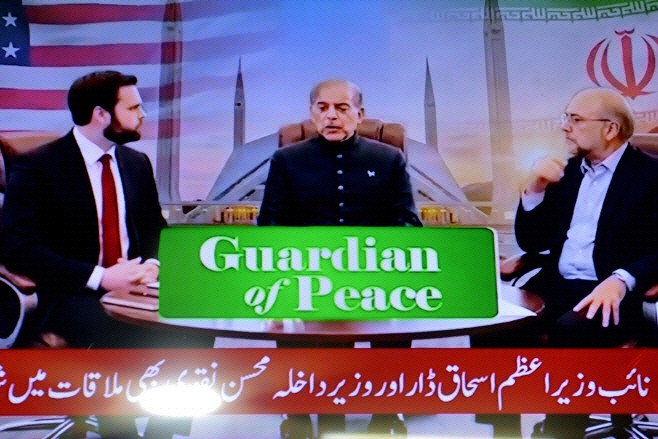 |
| J.D. Vance (left) and Mohammad Bagher Ghalibaf (right) hold ceasefire negotiations under the mediation of Shehbaz Sharif at a hotel in Islamabad, Pakistan, on April 11, in a photo captured from a TV screen. / EPA-Yonhap |
Trump signals confusion over talks, raises bar above 2015 nuclear deal
Trump gave inconsistent remarks regarding the negotiation schedule and participants, adding uncertainty to the already fragile talks.
Fox News host Maria Bartiromo wrote on X that Trump had said a deal could be reached “tonight,” but Trump later told Bloomberg that negotiations would begin on April 21.
Conflicting reports also emerged over whether J.D. Vance had departed for Pakistan. Trump claimed Vance would “arrive soon,” while Reuters reported that he was still in the United States. The New York Times said Vance was expected to leave Washington, D.C. on April 21 for Islamabad.
Analysts say the mixed signals may be a deliberate tactic to confuse negotiating counterparts, though some suggest they could also reflect psychological strain amid the prolonged conflict.
Trump also raised the benchmark for any potential agreement. In a post on Truth Social, he said the deal currently under discussion would be “much better” than the 2015 Iran nuclear agreement reached under Barack Obama—formally known as the Joint Comprehensive Plan of Action (JCPOA).
In a PBS interview, Trump reaffirmed that his primary objective is to ensure that Iran “cannot have nuclear weapons.”
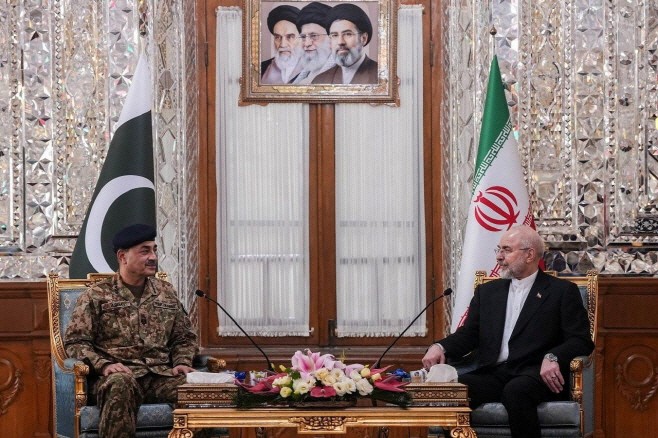 |
| Mohammad Bagher Ghalibaf meets with Asim Munir during his visit to Tehran on April 16, as part of mediation efforts for ceasefire talks between Iran and the United States. / Office of the Iranian Parliament Speaker · Reuters · Yonhap |
Iran resists pressure, delays decision on talks
Iran has rejected U.S. pressure while postponing a decision on whether to participate in ceasefire negotiations, exposing internal tensions between its foreign ministry and military leadership.
Masoud Pezeshkian said on X that “signals from U.S. officials are unconstructive and contradictory, ultimately amounting to demands for Iran’s surrender,” adding that “the Iranian people will never yield to coercion or pressure.”
Abbas Araghchi also criticized Washington during a phone call with Ishaq Dar, saying that “contradictory positions and threatening rhetoric from the United States are fundamental obstacles to diplomacy,” according to Iran’s Tasnim News Agency. He added that Iran would “make a decision after considering all aspects.”
Internal divisions have become increasingly visible. After Araghchi announced the reopening of the Strait of Hormuz on April 17, Iran’s military reversed the move the following day, reimposing restrictions and declaring that passage would not be allowed without naval approval.
Analysts say the military is effectively exercising veto power over diplomatic proposals, and this internal conflict appears to be a key factor delaying Iran’s decision on whether to join a second round of talks.
Tasnim, citing sources, reported that the decision not to attend negotiations “has not changed so far.” Esmaeil Baghaei also said in a briefing that “no plan or decision has been made regarding the next round of negotiations.”
Pakistan steps up mediation efforts
Asim Munir, a key power figure in Pakistan, reportedly told Donald Trump that the U.S. maritime blockade on Iran is a major obstacle to negotiations. Trump responded that he would “consider” the issue, according to a Pakistani security source cited by Reuters.
Shehbaz Sharif also spoke with Pezeshkian for 45 minutes, reaffirming Pakistan’s role as a “sincere mediator” for lasting peace and regional stability, according to the Associated Press.
Reuters, citing a senior Iranian official, reported that Iran is “positively reviewing” participation in a second round of talks, though no final decision has been made. Meanwhile, Pakistan Observer reported that an Iranian delegation is expected to arrive in Islamabad on April 21.
Baghaei emphasized that Pakistan is “the only official mediator” in the diplomatic process between Iran and the United States, while adding that Iran does not accept any deadlines or ultimatums when it comes to safeguarding its national interests.
#US #Iran #ceasefire #Donald Trump #negotiations
Copyright by Asiatoday
Most Read
-
1
Trump shares map on social media labeling Strait o..

-
2
Kia Sportage outperforms Mazda CX-5 in German auto..

-
3
Houthis launch successive attacks on Saudi airport..

-
4
U.S. deploys carrier, 10,000 more troops to Middle..

-
5
Trump rejects Iran's offer to open Strait of Hormu..

-
6
N. Korea conducts first swarm attack drill with dr..

-
7
U.S.-China summit falls short on substance as Trum..

PEOPLE






HEADLINE NEWS
- Seoul dismisses Ukraine's claim of 'S. Korean support for Russia' as "inaccurate and inappropriate"
- S. Korea, Japan race to develop nuclear-powered submarines
- Henri Kagan, Kenso Soai win Nobel Prize in Chemistry for uncovering how mol..
- Vance says Alaska LNG cooperation will move forward with Seoul's current or..

-
Address : In-Young Bldg., 34, Uisadang-daero 1-gil, Yeongdeungpo-gu, Seoul
Copyright by ASIATODAY CO., LTD. All rights resereved