



Samsung ramps up US Taylor fab, eyes foundry rebound
Apr 20, 2026, 08:25 am


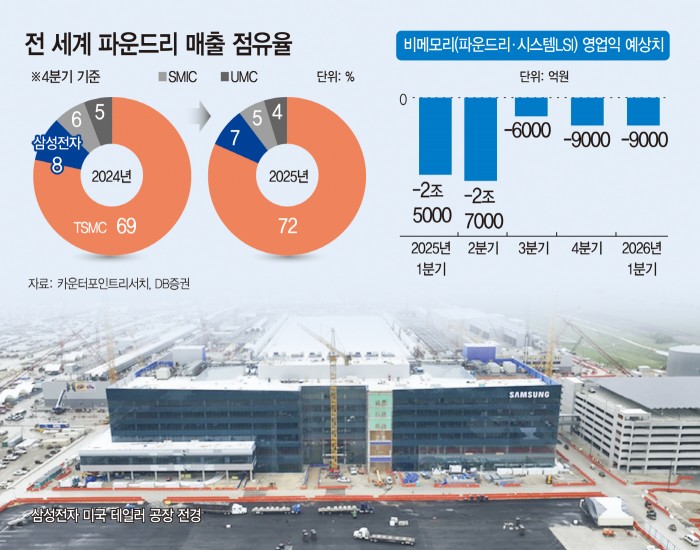 |
| Samsung Electronics’ Taylor fab in Texas prepares for equipment move-in ahead of operations. |
Samsung Electronics is moving closer to full-scale operations at its Taylor, Texas semiconductor plant, a key hub in its foundry strategy, as it seeks to regain ground in the global chip manufacturing race.
The company is set to hold an equipment move-in ceremony on April 24 at the Taylor fab, attended by executives including the head of its foundry division, along with partners from the materials, parts, and equipment sectors. The move signals that preparations for mass production are proceeding on schedule, with major equipment installation and hiring accelerating this year.
Samsung first announced the Taylor facility in 2021 as a next-generation foundry base with a $17 billion investment. Including additional funding, total investment has risen to $37 billion. Equipment installation has been underway since early this year, alongside recruitment for key roles in infrastructure, quality, and supply chain management.
The fab’s first major client is Tesla. Samsung signed a 23 trillion won (approximately $17 billion) foundry deal with Tesla last July to manufacture autonomous driving AI chips. Production of Tesla’s AI5 and AI6 chips is expected to begin as early as the second half of this year.
Tesla CEO Elon Musk recently said on social media that the A15 chip design has been completed, adding, “I’d like to thank Samsung Electronics and TSMC for helping enable production.”
As the Taylor fab nears launch, expectations are growing for a turnaround in Samsung’s foundry business, which has struggled in recent years. While the company does not disclose detailed figures, analysts estimate that its non-memory division, including foundry and System LSI, posted losses of around 7 trillion won last year.
Samsung’s global foundry market share has also declined. According to industry data, it held about 7% in the fourth quarter, compared to TSMC’s dominant 72%, widening the gap between the two rivals.
Industry watchers point to supply constraints at TSMC as a potential opportunity for Samsung. TSMC has acknowledged surging AI demand and is expanding infrastructure, including additional cleanrooms. Its most advanced 2–3nm process lines are reportedly fully booked through 2027.
This bottleneck could push customers toward Samsung’s advanced nodes. The company’s 2nm process at the Taylor fab is said to have achieved yields in the high-50% range, approaching the 60% threshold generally considered viable for stable mass production.
However, Tesla’s long-term plans introduce uncertainty. The company has announced a “TerraFab” initiative — a massive semiconductor production complex aiming to handle design through manufacturing in-house — and has reportedly sought technical support from Samsung.
Samsung is said to have countered by offering increased production capacity at its Taylor fab instead of direct technical assistance. Still, with TerraFab targeting annual output on the terawatt scale, analysts warn it could eventually threaten Samsung’s foundry orders.
An industry official noted, “The TerraFab project could disrupt the duopoly of Samsung and TSMC faster than expected. Losing Tesla, a key customer for advanced processes, would be a significant blow.”
#Samsung Electronics #Taylor fab #foundry #Tesla #AI chips
Copyright by Asiatoday
Most Read
-
1
Kia Sportage outperforms Mazda CX-5 in German auto..

-
2
Houthis launch successive attacks on Saudi airport..

-
3
Saudi Arabia, Iran hold first diplomatic talks to..

-
4
U.S. deploys carrier, 10,000 more troops to Middle..

-
5
Saudi airport in Riyadh struck again, leaving at l..

-
6
Putin's ally visits China on the 8th ahead of APEC..

-
7
Chinese military support and training center opens..

PEOPLE






HEADLINE NEWS

-
Address : In-Young Bldg., 34, Uisadang-daero 1-gil, Yeongdeungpo-gu, Seoul
Copyright by ASIATODAY CO., LTD. All rights resereved