



Musk says Tesla AI5 design complete, Samsung role expands
Apr 16, 2026, 11:39 am


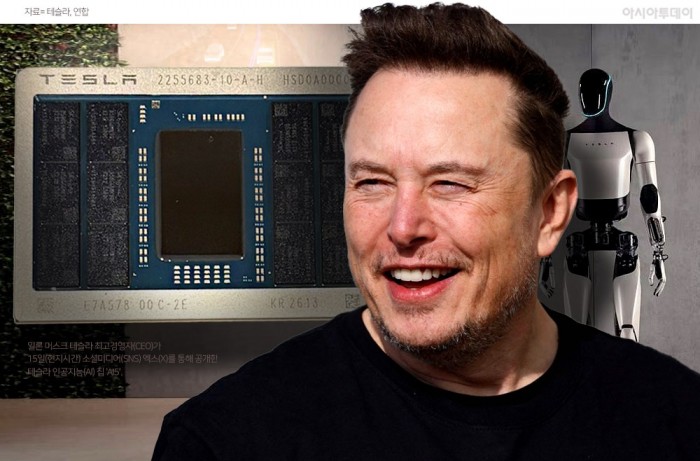 |
| Elon Musk shares Tesla’s AI chip “AI5” design update via social media. / Tesla·Yonhap Graphic by Park Jong-kyu |
Elon Musk announced on April 15 that Tesla has completed the design of its next-generation artificial intelligence chip, AI5, marking a key step in the company’s semiconductor self-reliance strategy.
The development signals that Tesla’s roadmap to internalize chip production—centered on autonomous driving and robotics—is entering a more concrete phase. AI5 will be manufactured jointly by Samsung Electronics and TSMC, while the next-generation AI6 chip is expected to be produced exclusively by Samsung.
AI5 Tape-Out Completed, Dual Production Strategy Confirmed
Musk said on social media platform X that “Tesla AI chip design team just completed the AI5 tape-out,” referring to the stage when chip design is finalized and sent to foundries for initial production.
He added, “Thanks to Samsung and TSMC,” confirming the dual manufacturing structure. The shared production model is seen as a strategy to diversify supply chain risks.
Musk also described AI5 as “one of the most produced AI chips in history,” signaling plans for large-scale manufacturing.
AI5 to Power Autonomous Driving and Optimus Robot
AI5 will be deployed in Tesla’s full self-driving (FSD) vehicles and its humanoid robot, Optimus. The chip is a core part of Tesla’s in-house semiconductor lineup aimed at reducing reliance on third-party hardware.
By strengthening its own computing capabilities, Tesla is seeking greater control over its AI systems.
AI6 to Shift to Samsung-Only Production
Musk also revealed that AI6 and Dojo 3 chips are currently under development. AI6 is expected to be manufactured solely by Samsung, with a tape-out targeted for December this year.
The transition from a shared production model for AI5 to exclusive manufacturing for AI6 suggests an expanded role for Samsung and reflects Tesla’s move toward a broader multi-chip AI strategy.
Minor Tagging Error Draws Attention
In his post, Musk mistakenly tagged “TSC” instead of TSMC, likely due to the latter not operating a
#Elon Musk #Tesla #AI chip #AI5 #AI6
Copyright by Asiatoday
Most Read
-
1
Kia Sportage outperforms Mazda CX-5 in German auto..

-
2
Houthis launch successive attacks on Saudi airport..

-
3
Saudi Arabia, Iran hold first diplomatic talks to..

-
4
U.S. deploys carrier, 10,000 more troops to Middle..

-
5
Saudi airport in Riyadh struck again, leaving at l..

-
6
Putin's ally visits China on the 8th ahead of APEC..

-
7
Chinese military support and training center opens..

PEOPLE





HEADLINE NEWS

-
Address : In-Young Bldg., 34, Uisadang-daero 1-gil, Yeongdeungpo-gu, Seoul
Copyright by ASIATODAY CO., LTD. All rights resereved