



Hyundai to build science museum for future talent
Apr 16, 2026, 11:45 am


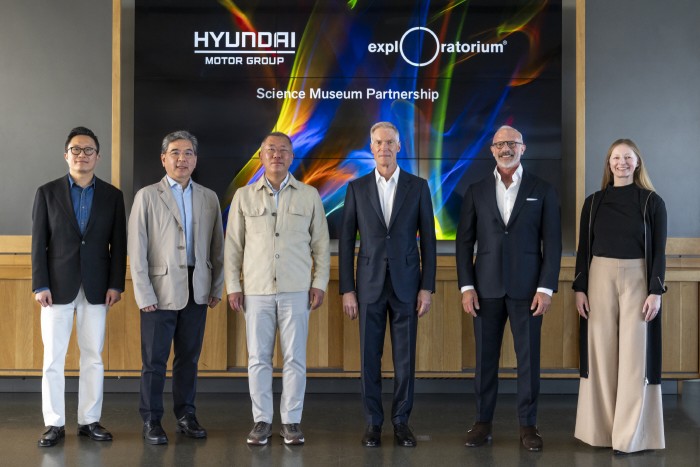 |
| (From left) Sungwon Jee, Executive Vice President and Head of Hyundai Motor Group Brand Experience, Jaehoon Chang, Vice Chair of Hyundai Motor Group, Euisun Chung, Executive Chair of Hyundai Motor Group, William F. (Bill) Mellin, Chair of the Board of Trustees at the Exploratorium, Lindsay Bierman, the Sakurako and William Fisher Executive Director and CEO of the Exploratorium, Dr. Anne Richardson, Chief Experience Officer of the Exploratorium. / Hyundai Motor Group |
Hyundai Motor Group announced plans to establish an experiential science museum in Korea as part of efforts to promote science education and nurture future talent, in partnership with Exploratorium.
The group signed a strategic partnership agreement with the Exploratorium in San Francisco on April 15, officially unveiling the project aimed at advancing science culture innovation and supporting the development of future scientific talent.
The initiative is part of Hyundai Motor Group’s broader vision to foster foundational science and transform science education, which underpin advanced industries such as mobility, robotics, and artificial intelligence.
The signing ceremony was attended by Euisun Chung, Executive Chair of Hyundai Motor Group; Jaehoon Chang, Vice Chair; and Sungwon Jee, Executive Vice President and Head of Hyundai Motor Group Brand Experience. It also included Exploratorium officials including William F. (Bill) Mellin, Chair of the Board of Trustees; Lindsay Bierman, the Sakurako and William Fisher Executive Director and CEO; and Dr. Anne Richardson, Chief Experience Officer.
“A Platform for Science Education and Curiosity”
Chung said, “Hyundai Motor Group continues to take on new challenges in advanced science fields such as mobility and artificial intelligence to contribute to humanity and future society.”
He added, “The experiential science museum we will create with the Exploratorium is expected to nurture curiosity and a spirit of inquiry, serving as a differentiated platform for science education for a better future.”
Bierman also highlighted the significance of the collaboration, saying it underscores the importance of uniquely human qualities such as curiosity, insight, and agency—traits that cannot be replaced by machines.
A Global Model for Hands-On Science Learning
Founded in 1969 by physicist Frank Oppenheimer, the Exploratorium is internationally recognized for pioneering the “hands-on” exhibition model, where visitors learn through direct interaction and experimentation.
The museum attracts over 1 million visitors annually and features more than 650 exhibits covering a wide range of topics, including science, art, psychology, social culture, and climate change.
More than 80% of science museums worldwide are estimated to have developed based on the Exploratorium’s interactive exhibition model.
Science Hub at GBC by 2032
The planned science museum will be built at Hyundai Motor Group’s Global Business Complex (GBC), with a target opening year of 2032.
Designed as a participatory space, the museum will move beyond passive viewing to allow visitors to explore, experiment, and learn through direct engagement.
Experts from diverse fields—including scientists, educators, and artists—will participate in exhibition planning and research, while educational programs will be developed in collaboration with schools and local communities.
Hyundai Motor Group said the facility will also serve as a “science community platform,” helping expand scientific culture and inspire creative thinking among future generations.
#Hyundai Motor Group #Chung Euisun #Exploratorium #science museum #STEM education
Copyright by Asiatoday
Most Read
-
1
Kia Sportage outperforms Mazda CX-5 in German auto..

-
2
Houthis launch successive attacks on Saudi airport..

-
3
Saudi Arabia, Iran hold first diplomatic talks to..

-
4
U.S. deploys carrier, 10,000 more troops to Middle..

-
5
Saudi airport in Riyadh struck again, leaving at l..

-
6
Putin's ally visits China on the 8th ahead of APEC..

-
7
Chinese military support and training center opens..

PEOPLE






HEADLINE NEWS

-
Address : In-Young Bldg., 34, Uisadang-daero 1-gil, Yeongdeungpo-gu, Seoul
Copyright by ASIATODAY CO., LTD. All rights resereved