



Hyundai’s 9trn won Saemangeum project gains momentum
Apr 03, 2026, 08:32 am


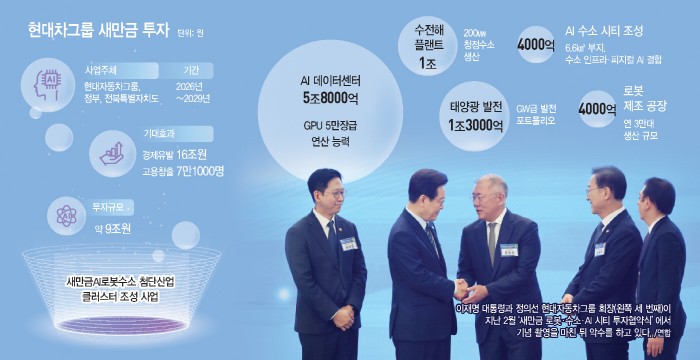 |
A 9 trillion won ($6.7 billion) investment project in Saemangeum led by Chung Euisun has entered full-scale implementation, marking a major step toward regional economic development in South Korea.
Hyundai Motor Group is accelerating preparations with the goal of completing design work within this year and beginning construction in 2027. The project includes an AI data center, a robotics manufacturing facility, and hydrogen production infrastructure.
The government and local authorities, including North Jeolla Province, are currently reviewing policy support measures based on the group’s requests. These include infrastructure such as electricity and water supply, as well as subsidies and regulatory incentives. A comprehensive government support plan is expected by May.
In line with the project, Hyundai recently established a dedicated task force, the Robot-Hydrogen Project Management Office (RH PMO), to oversee execution.
The investment plan, first announced in late February, includes building a 200-megawatt water electrolysis plant with an investment of 1 trillion won to produce clean hydrogen.
Following a joint investment agreement, Hyundai and local officials held a meeting on March 31 to review progress on 57 proposed tasks, including 25 under provincial jurisdiction. Discussions also covered subsidy policies for hydrogen production and additional regional support measures.
“We are thoroughly preparing to ensure the success of this investment,” a Hyundai executive said. “This is the first time we have created such a large-scale dedicated organization.”
The project is widely seen as a private-sector response to President Lee Jae-myung’s regional development strategy, known as “5 hubs and 3 special zones,” aimed at decentralizing economic growth.
Prime Minister Kim Min-seok also highlighted the investment as a milestone for region-led growth, emphasizing its potential to reshape local economies.
Industry experts expect the large-scale data center to trigger expansion in power infrastructure, telecommunications networks, and related industries. Combined with robotics and hydrogen sectors, the project could create a high-value industrial cluster integrating production, energy, and data.
The initiative is also expected to help disperse advanced industries beyond the capital region, create jobs, and attract population inflows, setting a precedent for future corporate investments in regional areas.
#Hyundai Motor Group #Chung Euisun #Saemangeum #AI data center #hydrogen
Copyright by Asiatoday
Most Read
-
1
Kia Sportage outperforms Mazda CX-5 in German auto..

-
2
Houthis launch successive attacks on Saudi airport..

-
3
Saudi Arabia, Iran hold first diplomatic talks to..

-
4
U.S. deploys carrier, 10,000 more troops to Middle..

-
5
Saudi airport in Riyadh struck again, leaving at l..

-
6
Putin's ally visits China on the 8th ahead of APEC..

-
7
Chinese military support and training center opens..

PEOPLE






HEADLINE NEWS

-
Address : In-Young Bldg., 34, Uisadang-daero 1-gil, Yeongdeungpo-gu, Seoul
Copyright by ASIATODAY CO., LTD. All rights resereved