



Korea growth steady despite global slowdown
Apr 15, 2026, 09:15 am


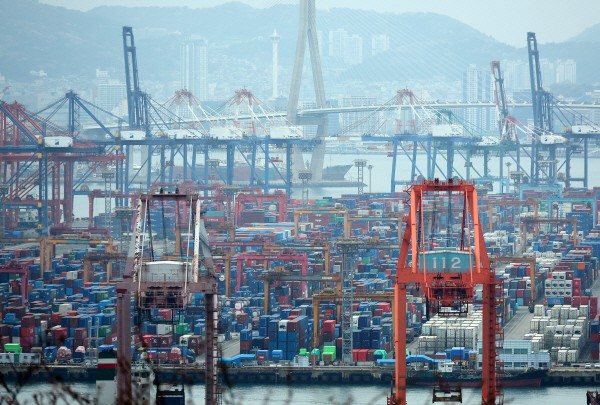 |
| Containers are stacked at the Sinseondae terminal in Busan Port. /Yonhap News |
The International Monetary Fund has maintained South Korea’s economic growth forecast at 1.9% for 2026, despite lowering its global outlook amid geopolitical uncertainties.
In its April World Economic Outlook released on April 14, the IMF projected South Korea’s growth at 1.9%, unchanged from its January estimate and slightly above the average for advanced economies at 1.8%. Inflation in South Korea is expected to reach 2.5% this year.
The IMF lowered its global growth forecast from 3.3% to 3.1%, citing rising energy prices, inflationary pressures, and financial market instability stemming from the prolonged Middle East conflict.
Despite these global headwinds, South Korea’s economy is expected to remain relatively resilient. Strong export performance—particularly in semiconductors—has helped offset external shocks. In addition, expectations of increased government spending through a supplementary budget have supported the outlook.
A government official said, “Although the economy has been affected by the Middle East conflict, robust exports and the impact of the supplementary budget have helped compensate for the downside pressure.”
The IMF’s projections assume that the conflict will stabilize after several weeks, allowing energy production and exports to gradually normalize by mid-year. However, it warned that growth forecasts could be revised downward depending on how the situation unfolds.
Under more adverse scenarios, including a sharper rise in oil prices, global growth could fall further to between 2.5% and 2%, which would also exert downward pressure on South Korea’s economy.
On inflation, the IMF raised its global forecast to 4.4%, up 0.6 percentage points from previous estimates, while projecting South Korea’s inflation at 2.5%.
The IMF assessed that “downside risks dominate” the global economic outlook, pointing to potential supply chain disruptions, financial market corrections linked to reassessments of artificial intelligence profitability, and the spread of protectionism.
It recommended that policymakers prioritize price stability while adopting flexible responses tailored to each country’s exposure to commodity markets and inflation expectations. The IMF also noted that temporary market interventions or capital flow management measures could be considered to address excessive exchange rate volatility.
Meanwhile, the South Korean government said it will maintain its current emergency response system until a formal end to the conflict is declared, while swiftly executing a 26.2 trillion won supplementary budget to stabilize prices, supply chains, vulnerable sectors, and financial markets.
#IMF #South Korea economy #growth forecast #exports #supplementary budget
Copyright by Asiatoday
Most Read
-
1
Celltrion’s Omlyclo gains ground in major European..

-
2
Trump demands rates fall below 1% as Fed hikes for..

-
3
Trump makes $1 trillion bet ahead of midterm elect..

-
4
Iran resumes ballistic missile production, assembl..

-
5
Trump warns countries not helping U.S. must pay re..

-
6
Apple launches first foldable, 1 million won prici..

-
7
Turkish Airlines named main club partner of Liverp..

PEOPLE







-
Address : In-Young Bldg., 34, Uisadang-daero 1-gil, Yeongdeungpo-gu, Seoul
Copyright by ASIATODAY CO., LTD. All rights resereved