



Hyundai shifts to AI robotics manufacturing
Apr 15, 2026, 09:03 am


 |
Hyundai Motor Group is accelerating a major shift in manufacturing strategy, focusing on human-robot collaboration powered by artificial intelligence and robotics.
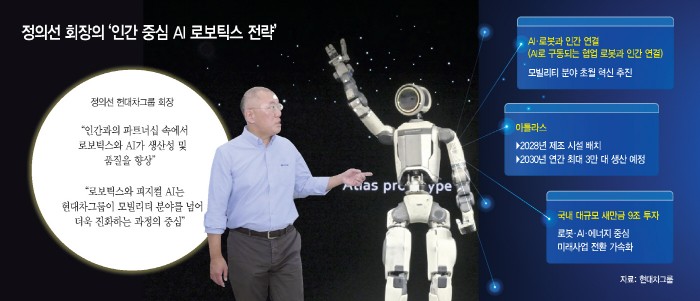
Chairman Chung Eui-sun recently unveiled the group’s “human-centered AI robotics” vision, positioning robotics and physical AI at the core of its evolution beyond traditional mobility.
Speaking ahead of the World Economy Summit in Washington, D.C., Chung said, “Robotics and physical AI are central to Hyundai Motor Group’s transformation beyond mobility,” adding that the company is working to connect advanced AI-driven robots with human workers to enhance productivity and quality.
A key part of the strategy involves deploying humanoid robots developed by Boston Dynamics. Hyundai plans to introduce its humanoid robot Atlas into manufacturing facilities by 2028 and scale up production to as many as 30,000 units annually by 2030.
The move signals a broader transition from conventional automobile manufacturing to an AI-based collaborative production system. Atlas is expected to combine Hyundai’s manufacturing data and production expertise with Boston Dynamics’ robotics technology, enabling real-world human-robot collaboration across industrial environments.
The company is also reinforcing this shift through a large-scale investment project in Saemangeum. Hyundai plans to invest about 9 trillion won to build a future technology cluster on a 1.124 million square meter site. The project includes robotics manufacturing facilities, component clusters, water electrolysis plants, AI data centers, a 1GW solar power system, and an AI-powered hydrogen city.
However, labor tensions remain a challenge. Hyundai’s labor union has strongly opposed the introduction of Atlas robots into production lines without prior agreement, stating that “not a single unit can be brought in without labor-management consensus.”
Despite this, Hyundai maintains that collaboration—not competition—between humans and robots is the foundation of its long-term vision. Industry observers note that robots can handle physically demanding, repetitive, and hazardous tasks with speed and precision, while human workers can focus on higher-value roles such as supervision, training, and system optimization.
Chung emphasized that Hyundai’s strength lies in its flexibility and resilience amid a rapidly evolving global market. “Our approach combines global expansion with regional agility, allowing us to maintain differentiated competitiveness in each market,” he said, adding that increasing competition serves as a driver of innovation.
#Hyundai Motor Group #Chung Eui-sun #AI robotics #Boston Dynamics #Atlas robot
Copyright by Asiatoday
Most Read
-
1
Kia Sportage outperforms Mazda CX-5 in German auto..

-
2
Houthis launch successive attacks on Saudi airport..

-
3
Saudi Arabia, Iran hold first diplomatic talks to..

-
4
U.S. deploys carrier, 10,000 more troops to Middle..

-
5
Saudi airport in Riyadh struck again, leaving at l..

-
6
Putin's ally visits China on the 8th ahead of APEC..

-
7
Chinese military support and training center opens..

PEOPLE






HEADLINE NEWS

-
Address : In-Young Bldg., 34, Uisadang-daero 1-gil, Yeongdeungpo-gu, Seoul
Copyright by ASIATODAY CO., LTD. All rights resereved