



Democrats surge on Lee approval ratings
Apr 15, 2026, 08:44 am


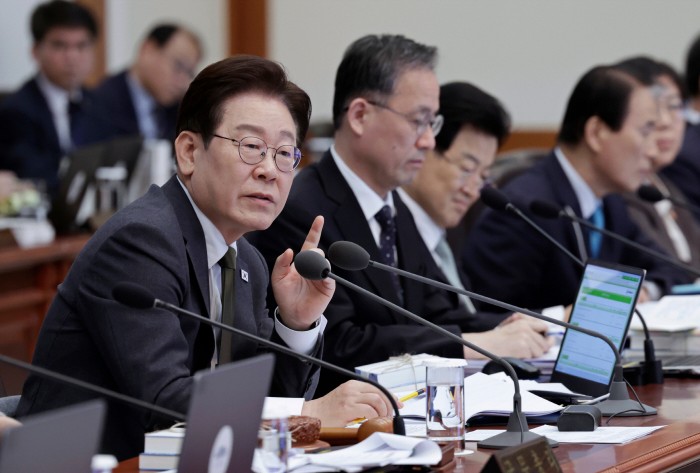 |
| President Lee Jae-myung presided over a Cabinet meeting and an emergency economic review meeting at the presidential office on April 14. /Yonhap News |
South Korea’s ruling Democratic Party is gaining momentum ahead of the June 3 local elections, buoyed by President Lee Jae-myung’s approval ratings in the 60% range, while the opposition struggles to mount an effective challenge.
According to political sources on April 14, a Realmeter poll commissioned by Energy Economy News surveyed 2,508 adults nationwide from April 6 to 10 and found President Lee’s job approval rating at 61.9%, up 0.7 percentage points from the previous week.
In a separate party approval survey conducted on April 9–10 among 1,002 respondents, the Democratic Party recorded 50.6%, also up 0.7 percentage points, widening its lead over the opposition.
Analysts attribute the parallel rise in approval ratings to the administration’s governance approach, particularly its focus on economic and livelihood issues. The presidential office has emphasized practical responses, including efforts to secure energy supplies and stabilize logistics amid worsening conditions in the Middle East, while holding emergency economic review meetings to address supply chain concerns.
Rep. Park Sung-joon of the Democratic Party said in a recent broadcast, “The pragmatic governance of the Lee administration is giving the public a sense of stability, creating positive momentum,” adding that “the president’s active leadership is directly translating into both approval ratings and electoral energy.”
In contrast, the opposition People Power Party has struggled to find a breakthrough. While it has focused on criticizing the administration and promoting the need to check the ruling power, it has yet to present clear policy alternatives or strong messaging to resonate with voters.
Recent polls show the approval gap between the two parties widening to as much as 20 percentage points, reflecting the opposition’s difficulty in regaining momentum. Although the election is structurally a one-on-one contest between ruling and opposition blocs, the overall landscape continues to tilt in favor of the ruling party.
Rep. Kim Sung-won of the People Power Party warned in a television interview, “If we fail to shake up the current dynamics, there is a real risk of losing overwhelmingly,” adding that “a passive strategy of waiting for the ruling party to make mistakes will only lead to defeat.”
Experts suggest that a significant shift in the political landscape is unlikely in the short term. While variables such as renewed constitutional reform debates, external geopolitical developments, and changes in economic conditions remain, they are not expected to substantially alter the current advantage held by the ruling party.
Political analyst Park Sang-byeong said, “Even as politics continues to be driven by confrontation rather than cooperation, neither side is significantly disrupting the existing structure. Under stable governance by an incumbent president, it is difficult for the overall dynamics to change dramatically.”
#Lee Jae-myung #Democratic Party #approval rating #local elections #People Power Party
Copyright by Asiatoday
Most Read
-
1
Trump demands rates fall below 1% as Fed hikes for..

-
2
Celltrion seeks rheumatoid arthritis indication ex..

-
3
Chinese e-commerce giants AliExpress, Temu and She..

-
4
Trump warns countries not helping U.S. must pay re..

-
5
Turkish Airlines named main club partner of Liverp..

-
6
China expels No. 2 military official Zhang Youxia..

-
7
Houthi rebels release video claiming downing of Sa..

PEOPLE






-
Address : In-Young Bldg., 34, Uisadang-daero 1-gil, Yeongdeungpo-gu, Seoul
Copyright by ASIATODAY CO., LTD. All rights resereved