



Local candidates unveil bold semiconductor investment pledges
Apr 13, 2026, 08:48 am


 |
With South Korea’s June 3 local elections approaching, candidates across the country are rolling out pledges to attract semiconductor investments, intensifying regional competition.
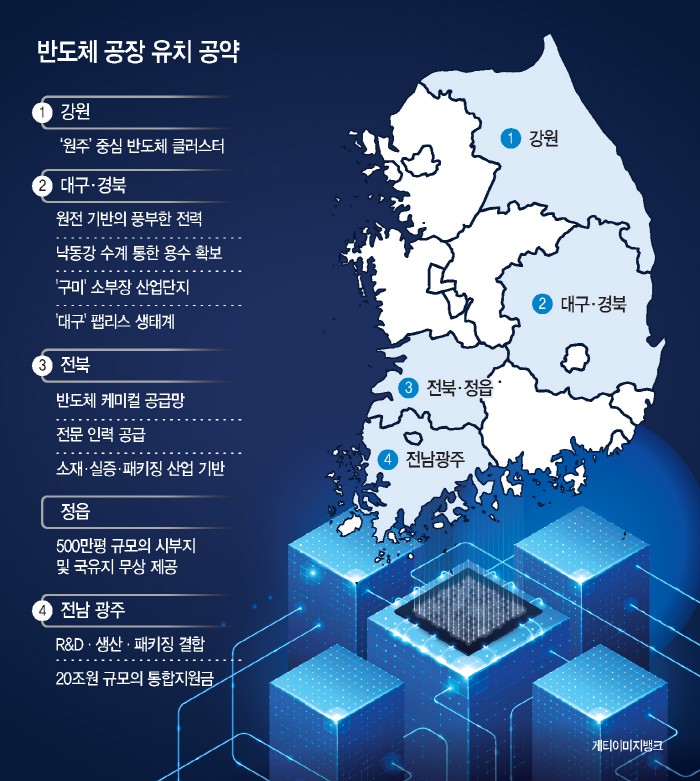
According to political sources on April 12, at least six local governments and candidates have put forward semiconductor-related pledges. As the government pushes for a mega semiconductor cluster in Yongin involving Samsung Electronics and SK hynix, regional candidates are emphasizing the need for a more decentralized industry structure, highlighting advantages such as power supply, water resources, and industrial infrastructure.
Bold pledge to bring production lines
One of the most striking proposals came from Yoo Young-ha, a candidate in the Daegu mayoral primary from the People Power Party, who pledged to attract Samsung Electronics’ semiconductor fabrication facilities (fabs) to Daegu.
Unlike typical investment pledges, Yoo’s proposal aims to relocate actual production lines to the Daegu-Gyeongbuk region. He plans to develop a 24.8 million-square-meter advanced industrial complex near the planned TK New Airport site and expand the semiconductor cluster to nearby Gumi.
Yoo argued that the existing Seoul metropolitan-centered cluster faces limitations, citing challenges in securing sufficient electricity and water. He emphasized that the Daegu-Gyeongbuk region offers stable power supply—supported by nearby nuclear plants—and ample water resources from the Nakdong River.
Step-by-step approach in Jeonbuk
In contrast, candidates in Jeonbuk are taking a more gradual approach. Lee Won-taek of the Democratic Party of Korea proposed focusing on semiconductor testing and packaging facilities rather than large-scale manufacturing plants.
He stressed that leveraging Jeonbuk’s strengths in advanced chemical supply chains could allow the region to build a sustainable role in the semiconductor ecosystem.
Full-cycle vision in Gwangju and South Jeolla
In the Gwangju–South Jeolla integrated mayoral race, candidates are proposing ambitious plans to build a full-cycle semiconductor ecosystem covering design, production, and packaging.
Kim Young-rok of the Democratic Party aims to attract global companies such as ASML and Applied Materials alongside domestic giants. Meanwhile, Min Hyung-bae proposed creating a new industrial belt linking AI, semiconductors, and mobility, supported by joint public-private investment.
Expansion beyond major cities
Semiconductor pledges are also emerging in gubernatorial and mayoral races beyond major metropolitan areas. Incumbent Gangwon Governor Kim Jin-tae has proposed building a semiconductor cluster centered in Wonju, while North Gyeongsang Governor Lee Cheol-woo aims to expand the industry based on the Gumi National Industrial Complex.
At the municipal level, independent candidate Kim Jae-sun in Jeongeup has pledged to attract semiconductor plants from Samsung Electronics and SK hynix, offering large-scale land and favorable transportation infrastructure.
Despite differences in approach—from attracting full-scale fabs to focusing on specific segments such as packaging—all candidates share a common goal: positioning semiconductors as a key driver of regional economic growth.
As competition intensifies, questions remain over the feasibility of these pledges, particularly given the massive infrastructure and investment requirements needed to support semiconductor manufacturing.
#local elections #semiconductor cluster #regional competition #Samsung Electronics #SK hynix
Copyright by Asiatoday
Most Read
-
1
Trump demands rates fall below 1% as Fed hikes for..

-
2
Celltrion seeks rheumatoid arthritis indication ex..

-
3
Chinese e-commerce giants AliExpress, Temu and She..

-
4
Trump warns countries not helping U.S. must pay re..

-
5
Turkish Airlines named main club partner of Liverp..

-
6
China expels No. 2 military official Zhang Youxia..

-
7
Houthi rebels release video claiming downing of Sa..

PEOPLE






-
Address : In-Young Bldg., 34, Uisadang-daero 1-gil, Yeongdeungpo-gu, Seoul
Copyright by ASIATODAY CO., LTD. All rights resereved