



US nuclear umbrella shaken as Korea and Japan reassess strategy
Apr 13, 2026, 08:37 am


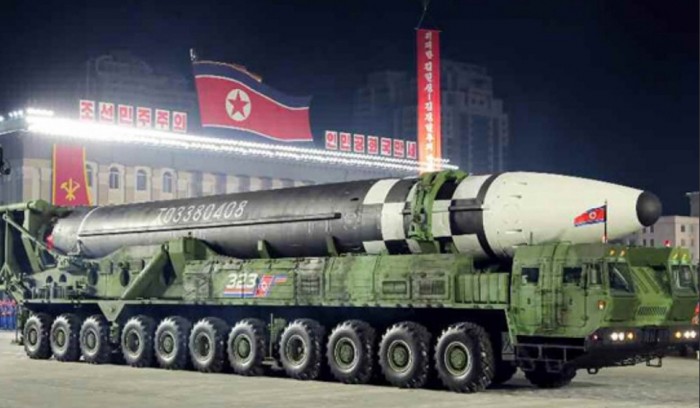 |
| North Korea unveiled a larger new intercontinental ballistic missile (ICBM) capable of targeting the U.S. mainland during a military parade marking the 75th anniversary of the Workers’ Party on October 10, 2020. The new ICBM is longer and wider than the Hwasong-15, and was carried on a 22-wheel transporter erector launcher (TEL). / Yonhap News, source: Rodong Sinmun website |
Security dynamics in Northeast Asia are rapidly shifting as doubts grow over the reliability of the United States’ nuclear umbrella, prompting renewed debate in South Korea and Japan over securing independent nuclear capabilities.
According to a recent report by the Council on Foreign Relations, both countries are moving beyond civilian nuclear energy and increasingly focusing on “nuclear latency”—the technical capability to develop nuclear weapons if necessary.
The report highlights how prolonged conflict involving Iran and shifting US strategic priorities under Donald Trump have raised concerns about the credibility of extended deterrence.
The redeployment of key US military assets from East Asia to the Middle East has further fueled anxiety in Seoul and Tokyo, intensifying calls for greater self-reliance in defense.
Energy crisis driving nuclear debate
The trigger for renewed nuclear discussions has been an energy crisis stemming from the Iran conflict. With the Strait of Hormuz effectively disrupted, both South Korea and Japan—heavily dependent on Middle Eastern oil and liquefied natural gas—have faced mounting energy security risks.
This has increased reliance on nuclear power, bringing issues such as uranium supply and enrichment capabilities to the forefront of national security agendas.
South Korea has sought greater autonomy in nuclear fuel processing, including enrichment and reprocessing technologies, though progress remains limited under existing agreements with the United States.
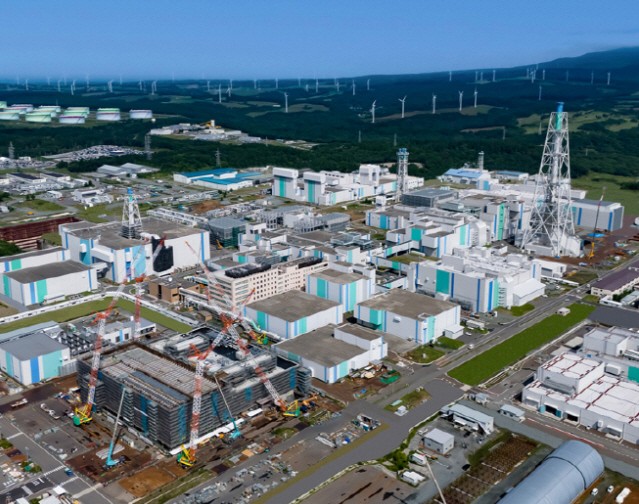 |
| The Rokkasho nuclear fuel reprocessing facility in Aomori Prefecture, Japan—the country’s largest of its kind—was constructed to extract and recycle plutonium and other materials from spent nuclear fuel. Construction began in 1993, was completed in 2012, and operations started in 2013. / Yonhap News |
Japan’s advanced nuclear readiness
Japan is widely viewed as having a significant advantage in nuclear latency. It possesses roughly 45 tons of weapons-grade plutonium and maintains advanced technological capabilities, enabling it to assemble nuclear weapons within months if a political decision is made.
Experts note that this stockpile alone provides Japan with substantial strategic leverage, effectively positioning it as a “threshold nuclear state.”
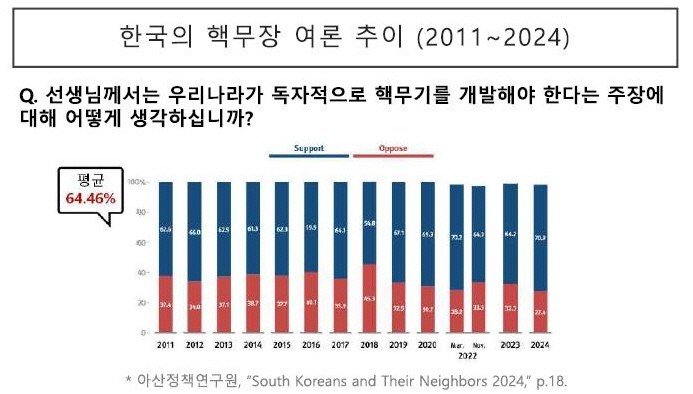 |
| A chart by the Asan Institute for Policy Studies showing trends in South Korean public support for independent nuclear armament from 2011 to 2024. Support reached 76.2% in 2025 and rose another 3.8 percentage points in 2026, surpassing 80% for the first time since the survey began in 2010. Opposition fell to 14.3%, down sharply from 23.8% the previous year, marking a record low. / Yonhap News, source: Asan Institute for Policy Studies |
Public opinion shifts in South Korea
Public sentiment in South Korea is also evolving. According to a survey by the Asan Institute for Policy Studies, more than 76% of respondents support developing an independent nuclear capability, marking a record high.
At the same time, confidence in US retaliation in the event of a North Korean nuclear attack has declined, reflecting growing uncertainty about alliance commitments.
Nuclear latency as a strategic alternative
Analysts suggest that rather than immediately pursuing nuclear weapons, South Korea is more likely to focus on building nuclear latency similar to Japan’s model—maintaining the capability without actual weaponization.
This approach could provide deterrence while avoiding international sanctions and diplomatic isolation.
However, challenges remain. The CFR report warns that China may respond with economic or military pressure if South Korea expands its nuclear capabilities, while North Korea has already condemned such moves.
Despite these risks, experts increasingly view a “nuclear domino” effect in Northeast Asia as difficult to avoid. As US global commitments expand and alliance reliability comes into question, both Seoul and Tokyo may feel compelled to pursue greater strategic autonomy.
At this critical juncture, analysts emphasize the need for careful policy decisions and a fundamental reassessment of the Korea-US alliance, as regional security enters an increasingly uncertain phase.
#nuclear umbrella #South Korea #Japan #nuclear latency #United States
Copyright by Asiatoday
Most Read
-
1
Trump demands rates fall below 1% as Fed hikes for..

-
2
Celltrion seeks rheumatoid arthritis indication ex..

-
3
Chinese e-commerce giants AliExpress, Temu and She..

-
4
Trump warns countries not helping U.S. must pay re..

-
5
Turkish Airlines named main club partner of Liverp..

-
6
China expels No. 2 military official Zhang Youxia..

-
7
Houthi rebels release video claiming downing of Sa..

PEOPLE






-
Address : In-Young Bldg., 34, Uisadang-daero 1-gil, Yeongdeungpo-gu, Seoul
Copyright by ASIATODAY CO., LTD. All rights resereved