



Lee pushes supply chain controls over Middle East risks
Apr 02, 2026, 09:15 am


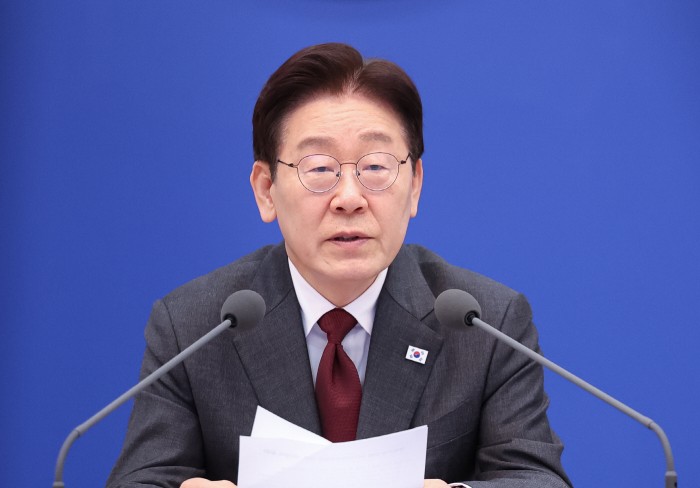 |
| President Lee Jae-myung speaks during an emergency economic inspection meeting held at the presidential office on April 1. / Yonhap |
President Lee Jae-myung on April 1 instructed all ministries to strengthen supply chain management by identifying key items and conducting daily monitoring of supply and price trends, citing growing instability in the Middle East.
Speaking at the third emergency economic inspection meeting held at the presidential office, Lee emphasized the need for real-time coordination with industries. “Each ministry in charge must establish hotlines with relevant sectors, maintain constant communication with the field, and accurately assess distribution conditions to implement necessary measures in a timely manner,” he said.
Lee also warned of possible regional imbalances, noting that even if national supply remains stable, certain areas could face temporary shortages. He called for a coordinated system among local governments to adjust supply volumes in advance.
The president further stressed the importance of diversifying supply chains by securing alternative overseas sources, while maintaining a balanced approach that considers international cooperation and trust. “Global supply chains are tightly interconnected. Excessive domestic control measures could backfire on our own economy,” he said, urging a strategic response that prioritizes national interest.
Lee announced that an emergency economic response system centered on the presidential office and the Prime Minister’s Office would be activated. “In extraordinary times, extraordinary responses are required,” he said, adding that he would personally oversee follow-up measures.
He noted that the month-long Middle East conflict has heightened uncertainty in energy supply, with ripple effects spreading across global supply chains and impacting daily life.
Lee also pledged strict action against misinformation. “Unclear information can fuel unnecessary suspicion and confusion. We must transparently disclose supply conditions and counter the spread of false information,” he said.
Calling for broader participation, Lee highlighted voluntary efforts by businesses and citizens, such as price freezes and energy conservation. “Such solidarity can turn a crisis into an opportunity,” he said, adding that the government would introduce additional support measures for vulnerable groups and urging the public to save energy and use public transportation.
#Lee Jae-myung #supply chain crisis #emergency economic meeting #Middle East tensions
Copyright by Asiatoday
Most Read
-
1
Trump demands rates fall below 1% as Fed hikes for..

-
2
Celltrion seeks rheumatoid arthritis indication ex..

-
3
Chinese e-commerce giants AliExpress, Temu and She..

-
4
Trump warns countries not helping U.S. must pay re..

-
5
Turkish Airlines named main club partner of Liverp..

-
6
China expels No. 2 military official Zhang Youxia..

-
7
Houthi rebels release video claiming downing of Sa..

PEOPLE







-
Address : In-Young Bldg., 34, Uisadang-daero 1-gil, Yeongdeungpo-gu, Seoul
Copyright by ASIATODAY CO., LTD. All rights resereved