



Busan global hub bill stalls ahead of final March plenary session
Mar 31, 2026, 09:33 am


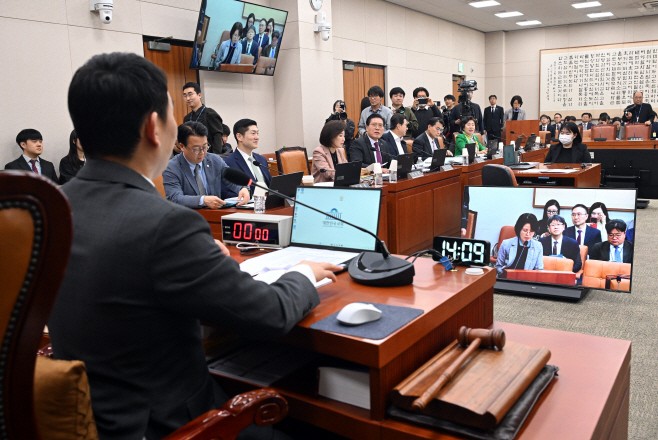 |
| Kim Yong-min, acting chair of the National Assembly Legislation and Judiciary Committee, presides over a plenary session at the National Assembly on March 30. / Song Ui-joo |
The “Busan Global Hub City Special Act” and the “Gangwon Special Act” failed to pass the National Assembly ahead of the final plenary session in March, after being excluded from the agenda of the Legislation and Judiciary Committee.
On March 30, the committee left both bills off its plenary meeting agenda, effectively preventing their passage at the March 31 plenary session.
Kim Yong-min, a lawmaker of the Democratic Party of Korea and the ruling party’s committee secretary, cited the failure to meet the required “cooling-off period” as the reason for exclusion. Under National Assembly rules, bills must undergo a five-day review period after passing a standing committee before being considered by the Legislation and Judiciary Committee. These bills had only completed four days as of March 30.
The People Power Party strongly protested the decision, calling it “a move that poured cold water” on the process.
Despite expectations of smooth passage, the exclusion triggered backlash. Park Heong-joon criticized the move, saying, “The Busan Global Hub City Special Act, long hoped for by Busan citizens, was not even placed on the committee’s agenda. This reveals the Democratic Party’s true face of treating Busan merely as an election tool.”
Joo Jin-woo of the People Power Party also sharply criticized Jeon Jae-soo, a Democratic Party lawmaker who led the bill, questioning why he did not speak out against his party.
Concerns over fairness were also raised. While a bill designating Labor Day as a public holiday—passed by a standing committee on the same day—was included in the agenda due to its urgency, the Busan and Gangwon-related bills were excluded.
A People Power Party official said, “Among bills submitted at the same time, some were included while others were excluded, which undermines fairness.”
Meanwhile, the Democratic Party plans to focus on passing livelihood-related bills agreed upon by both parties during the March 31 plenary session. Around 60 bills—including foreign exchange stabilization measures, industrial accident compensation, and support for victims of housing rental fraud—are expected to be prioritized.
#Busan Global Hub Act #Legislation and Judiciary Committee #South Korea politics
Copyright by Asiatoday
Most Read
-
1
Trump demands rates fall below 1% as Fed hikes for..

-
2
Celltrion seeks rheumatoid arthritis indication ex..

-
3
Chinese e-commerce giants AliExpress, Temu and She..

-
4
Trump warns countries not helping U.S. must pay re..

-
5
Turkish Airlines named main club partner of Liverp..

-
6
China expels No. 2 military official Zhang Youxia..

-
7
Houthi rebels release video claiming downing of Sa..

PEOPLE







-
Address : In-Young Bldg., 34, Uisadang-daero 1-gil, Yeongdeungpo-gu, Seoul
Copyright by ASIATODAY CO., LTD. All rights resereved