



Venezuelan leftist government faces internal split
Jun 05, 2026, 10:00 am


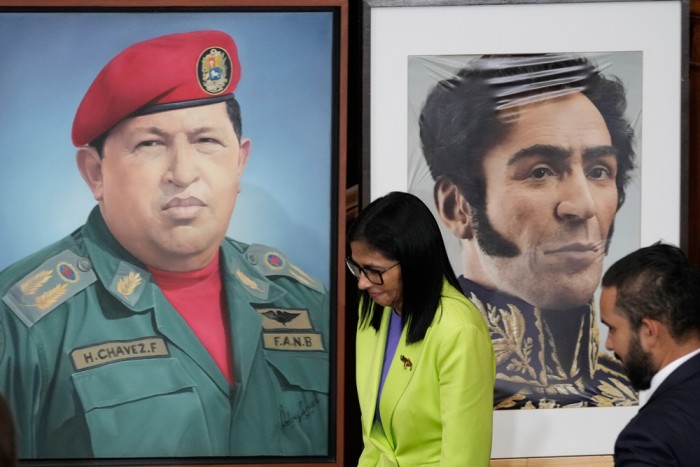 |
| Venezuelan interim president Delcy Rodríguez walks past portraits of former president Hugo Chávez (left) and independence leader Simón Bolívar at the National Assembly in Caracas on January 15 (local time). / AP |
The Wall Street Journal reported on June 3 (local time) that Venezuelan interim president Delcy Rodríguez, who has actively cooperated with U.S. administration policies, is facing backlash from her leftist political base, shaking her position.
Key figures in Chavismo—the socialist movement loyal to former president Hugo Chávez—have openly criticized Rodríguez for adopting what they see as an overly conciliatory stance while stabilizing the country and strengthening ties with the Trump administration.
Former ministers, party intellectuals, and leftist activists accuse her of surrendering sovereignty, opening the economy to foreign capital, and sidelining loyalists who resisted U.S. influence for decades.
One of the most vocal critics is Mario Silva, a founding member of the ruling United Socialist Party of Venezuela (PSUV) and architect of its propaganda system. After his long-running state TV program was canceled in March, Silva began broadcasting online, declaring, “We have already lost sovereignty, freedom, and independence,” in criticism of Rodríguez’s leadership.
Traditionally, the Chavista regime positioned itself as a bulwark against U.S. hegemony, strengthening ties with Russia, China, and Iran. But as the government increasingly relies on U.S. support, key insiders have expressed doubts about the regime’s sustainability.
Since Nicolás Maduro was ousted in January, Rodríguez’s government revised energy and mining regulations to attract foreign capital, handed over enriched uranium stored in research facilities to the U.S., and extradited former industry minister Alex Saab—Maduro’s close ally—to Miami to face money laundering charges.
Recent polls show Rodríguez struggling to secure support beyond pro-U.S. factions. A survey conducted by AtlasIntel and Bloomberg at the end of May found her approval rating at about 25%, down from 37% in February.
Her allies dismiss the criticism as attempts to artificially sow division. Pro-government lawmaker and former foreign minister Jorge Arreaza claimed on social media that “a psychological offensive is being waged against the Chavista regime.”
Kim Hyun-min
Most Read
-
1
Celltrion’s Omlyclo gains ground in major European..

-
2
Trump demands rates fall below 1% as Fed hikes for..

-
3
Trump makes $1 trillion bet ahead of midterm elect..

-
4
Iran resumes ballistic missile production, assembl..

-
5
Samsung Electronics, Mistral AI to jointly develop..

-
6
Trump warns countries not helping U.S. must pay re..

-
7
Apple launches first foldable, 1 million won prici..

PEOPLE






HEADLINE NEWS
- Trump to roll out ‘unprecedented welcome’ for Xi with B-2 bombers, F-22 fighters
- S. Korea, U.S., and Japan form united front on Taiwan and economic coercion..
- Trump administration moves to impose sweeping sanctions on International Cr..
- Xi to make state visit to U.S. Sept. 23-25, dispelling rumors over his heal..

-
Address : In-Young Bldg., 34, Uisadang-daero 1-gil, Yeongdeungpo-gu, Seoul
Copyright by ASIATODAY CO., LTD. All rights resereved