



President Lee urges electricity saving as KEPCO debt tops 200 trillion won
Mar 27, 2026, 09:20 am


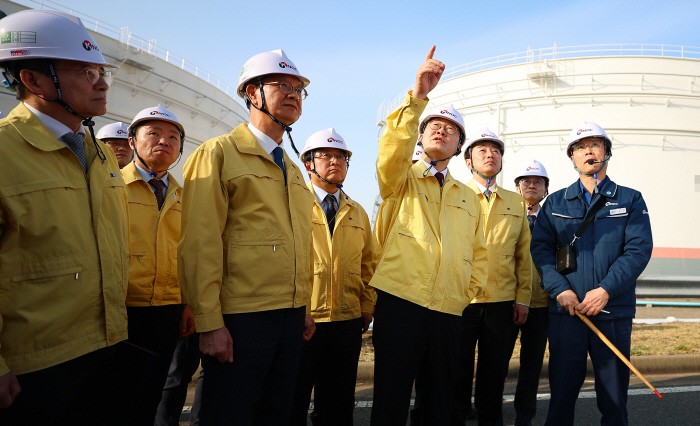 |
| President Lee Jae-myung inspects crude oil storage tanks at the Korea National Oil Corporation’s Seosan reserve base on March 26. / Yonhap |
President Lee Jae-myung on March 26 called for nationwide energy conservation, highlighting the growing financial burden of Korea Electric Power Corporation, whose debt has reached 200 trillion won.
Speaking at a second emergency economic review meeting at the presidential office, Lee said the government aims to keep electricity prices stable but warned that doing so could widen KEPCO’s losses.
“We will try to maintain electricity rates if possible,” Lee said, urging citizens to reduce power consumption. “I ask for your special cooperation in saving electricity.”
He noted that holding down electricity prices could increase demand, as consumers shift from fuel to electricity, further worsening the utility’s financial situation.
Lee also addressed broader concerns over the global energy crisis, saying the complex and intertwined supply chains make it difficult to accurately assess the full impact of ongoing conflicts. He emphasized the need for both government measures and public participation to overcome the situation.
“The debt of KEPCO stands at 200 trillion won, making this a very challenging situation,” he said. “I ask the public to take this into account and actively participate in energy conservation.”
The president also warned against profiteering amid the crisis, including price-fixing and hoarding, stating that such actions would be met with “zero tolerance.”
The government announced that fuel tax cuts on gasoline and diesel will be expanded to 15% and 25%, respectively, starting March 27.
Later in the day, Lee visited an oil storage facility operated by the Korea National Oil Corporation in Seosan, where he reviewed oil reserves and supply conditions and met with industry leaders.
He stressed the need for joint efforts among the government, businesses, and industry to secure crude oil supplies and reduce consumption.
“We must secure as much crude oil as possible and overcome this by reducing consumption,” Lee said, adding that addressing current challenges could help strengthen preparedness for future crises.
Industry officials at the meeting shared concerns over feedstock supply and called for government support, including diplomatic assistance in securing alternative sources. Lee pledged full policy and diplomatic backing, emphasizing that energy security is directly tied to the national economy.
#Lee Jae-myung #KEPCO debt #energy crisis #electricity saving #oil reserves
Copyright by Asiatoday
Most Read
-
1
Trump shares map on social media labeling Strait o..

-
2
Kia Sportage outperforms Mazda CX-5 in German auto..

-
3
Houthis launch successive attacks on Saudi airport..

-
4
U.S. deploys carrier, 10,000 more troops to Middle..

-
5
Trump rejects Iran's offer to open Strait of Hormu..

-
6
N. Korea conducts first swarm attack drill with dr..

-
7
U.S.-China summit falls short on substance as Trum..

PEOPLE






HEADLINE NEWS
- Seoul dismisses Ukraine's claim of 'S. Korean support for Russia' as "inaccurate and inappropriate"
- S. Korea, Japan race to develop nuclear-powered submarines
- Henri Kagan, Kenso Soai win Nobel Prize in Chemistry for uncovering how mol..
- Vance says Alaska LNG cooperation will move forward with Seoul's current or..

-
Address : In-Young Bldg., 34, Uisadang-daero 1-gil, Yeongdeungpo-gu, Seoul
Copyright by ASIATODAY CO., LTD. All rights resereved