



Oversight gap sparks debate on case referral revival
Mar 19, 2026, 08:41 am


 |
Calls are mounting to restore the “all-case referral” system as concerns grow over weakened oversight of police investigations following prosecutorial reforms in South Korea.
The debate comes after the removal of prosecutors’ authority to direct and supervise police and the Serious Crimes Investigation Office, raising concerns that key checks and balances in the criminal justice system have eroded.
Legal experts argue that without adequate judicial oversight, it has become increasingly difficult to filter out investigative errors, targeted probes or lenient handling of cases. As a result, proposals to reinstate the all-case referral system—under which all police-handled cases are sent to prosecutors—are gaining traction.
Under the previous system, prosecutors could review even cases that police had decided not to forward, providing an additional layer of scrutiny and giving victims a chance to have decisions reassessed. However, the system was abolished in 2021 when investigative authority was restructured, granting police the power to close cases independently.
Critics say the change has left a gap in oversight. In some instances, misconduct has surfaced only after prosecutors conducted supplementary investigations. In one recent case, a police officer was indicted for allegedly accepting bribes in exchange for influencing the handling of a fraud complaint—misconduct uncovered through prosecutorial follow-up.
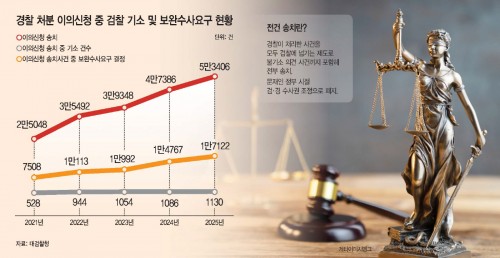
Statistics also underscore the issue. According to the Supreme Prosecutors’ Office, the number of cases reversed after prosecutorial review nearly doubled over the past four years. In 2025, 53,406 cases were forwarded to prosecutors following objections from complainants or victims, up from 25,048 in 2021.
The number of cases in which prosecutors overturned police decisions and pursued indictments has also steadily increased, rising from 528 in 2021 to 1,130 in 2025.
These figures suggest that a significant portion of police decisions are altered upon review, reinforcing arguments for reinstating broader oversight mechanisms such as all-case referral or expanded supplementary investigation powers.
The government has not yet made a final decision, leaving room for potential reforms. Justice Minister Jung Sung-ho previously indicated openness to reviewing the reinstatement of the system during a parliamentary session last year.
Legal professionals warn that without restoring checks between investigative bodies, the burden may ultimately fall on citizens. “Under the new system, cases can only be examined once they reach prosecutors, which may lead to significant delays,” a senior prosecutor said.
A former deputy prosecutor-turned-lawyer also criticized the current framework, saying it deprives case participants of opportunities for additional review. “In the end, the 피해 will be borne by the public,” he said.
#prosecution reform #police investigation #all-case referral #South Korea law
Copyright by Asiatoday
Most Read
-
1
Celltrion’s Omlyclo gains ground in major European..

-
2
Trump demands rates fall below 1% as Fed hikes for..

-
3
Hyundai Motor Group breaks ground on integrated st..

-
4
U.S. strikes 3 Iranian oil tankers, Iran vows reta..

-
5
Trump makes $1 trillion bet ahead of midterm elect..

-
6
Iran resumes ballistic missile production, assembl..

-
7
Samsung Electronics, Mistral AI to jointly develop..

PEOPLE







-
Address : In-Young Bldg., 34, Uisadang-daero 1-gil, Yeongdeungpo-gu, Seoul
Copyright by ASIATODAY CO., LTD. All rights resereved