



Korea to create NongHyup audit committee to tighten oversight
Mar 11, 2026, 09:29 am


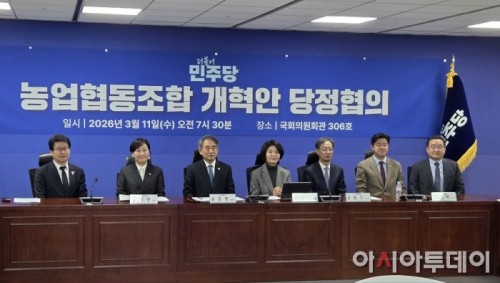 |
| Lawmakers from the Democratic Party and Agriculture Minister Song Mi-ryung pose for a photo during a government–party meeting on agricultural cooperative reform at the National Assembly Members’ Office Building in Seoul on March 11. / Shim Jun-bo |
South Korea’s ruling Democratic Party and the government on March 11 agreed to push forward a reform plan for the National Agricultural Cooperative Federation (NongHyup), including the creation of an independent external audit body to strengthen oversight.
The plan was confirmed during a government–party policy meeting at the National Assembly. Officials said a new organization tentatively named the NongHyup Audit Committee will be established as a separate legal entity to conduct integrated audits of the federation’s headquarters, its financial holding companies and subsidiaries, as well as regional cooperatives.
Agriculture Minister Song Mi-ryung said the new body is designed to eliminate blind spots in the cooperative system’s oversight structure.
“We will establish the NongHyup Audit Committee so that integrated audits can be carried out across the central organization, holding companies, subsidiaries and regional cooperatives without gaps,” Song said. “By classifying it as a separate corporation, we will ensure the independence of the auditing process.”
She added that the reform will also strengthen independence in personnel management and expand members’ oversight of key management decisions.
The proposal includes measures to broaden participation by cooperative members in the election of the NongHyup chairman and to increase penalties for vote-buying and other illicit practices in internal elections.
Ruling party officials said the reform plan follows President Lee Jae-myung’s directive for stricter audits and institutional improvements within the cooperative system.
Han Jeong-ae, policy chief of the Democratic Party, said recent inspection results revealed serious governance problems.
“More than 100 violations were uncovered in just one month of auditing, which shows that corruption had spread widely within the organization while internal control mechanisms failed to function properly,” she said.
Yoon Joon-byung, the party’s policy coordinator for the National Assembly’s agriculture committee, also stressed the need for stronger institutional oversight.
“Recent joint inspections exposed internal corruption and opaque decision-making,” Yoon said. “It is no longer possible to rely solely on autonomy to ensure proper management. We will push forward legislation quickly at the committee level to establish stronger institutional safeguards.”
Earlier, a joint government inspection team announced that a special audit of NongHyup had uncovered 14 suspected legal violations, including embezzlement of public funds and preferential lending. Authorities referred the cases for investigation and ordered corrective measures and institutional improvements in about 90 additional cases.
#NongHyup reform #National Agricultural Cooperative Federation #audit committee
Copyright by Asiatoday
Most Read
-
1
Trump shares map on social media labeling Strait o..

-
2
Kia Sportage outperforms Mazda CX-5 in German auto..

-
3
Houthis launch successive attacks on Saudi airport..

-
4
U.S. deploys carrier, 10,000 more troops to Middle..

-
5
Trump rejects Iran's offer to open Strait of Hormu..

-
6
N. Korea conducts first swarm attack drill with dr..

-
7
U.S.-China summit falls short on substance as Trum..

PEOPLE





HEADLINE NEWS
- Seoul dismisses Ukraine's claim of 'S. Korean support for Russia' as "inaccurate and inappropriate"
- S. Korea, Japan race to develop nuclear-powered submarines
- Henri Kagan, Kenso Soai win Nobel Prize in Chemistry for uncovering how mol..
- Vance says Alaska LNG cooperation will move forward with Seoul's current or..

-
Address : In-Young Bldg., 34, Uisadang-daero 1-gil, Yeongdeungpo-gu, Seoul
Copyright by ASIATODAY CO., LTD. All rights resereved