



Lee calls for early extra budget to minimize Middle East shock
Mar 11, 2026, 08:28 am


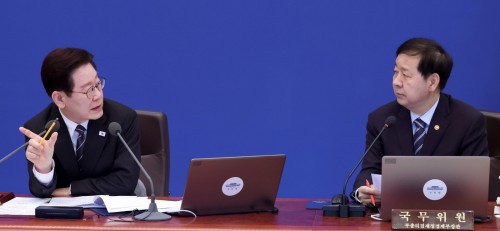 |
| President Lee Jae-myung speaks during a Cabinet meeting at the presidential office in Seoul on March 10. / Yonhap |
President Lee Jae-myung on March 10 formally signaled plans for an early supplementary budget, saying additional fiscal measures would likely be needed to cushion the economic impact of the Middle East crisis and rising oil prices.
Speaking at a Cabinet meeting in Seoul, Lee instructed government officials to prepare swiftly for an extra budget aimed at supporting vulnerable groups and businesses.
“To provide fiscal support for small businesses and struggling companies, an early supplementary budget will inevitably be necessary,” Lee said.
The president emphasized that the government must mobilize all available national resources to minimize the effects of external shocks on the economy and people’s livelihoods.
Lee also suggested targeted support for low-income households and vulnerable consumers, rather than implementing across-the-board fuel tax cuts. He asked officials to move quickly on additional measures, including a maximum price system for petroleum products, adjustments to energy taxes, direct consumer support, and expanded financial assistance.
Deputy Prime Minister and Finance Minister Koo Yun-cheol said the government expects to finance the supplementary budget without issuing additional government bonds.
“Semiconductor market conditions have recently improved, and there are additional resources from an active stock market,” Koo said. “We believe it will be possible to implement the supplementary budget at an appropriate scale without issuing new national debt.”
Lee also addressed controversy surrounding reports that the United States is relocating some air defense systems deployed in South Korea amid the ongoing conflict involving the United States, Israel, and Iran.
When asked whether the removal of certain air defense assets could weaken South Korea’s deterrence against North Korea, Lee said the country’s security posture remains intact.
“If you ask whether this severely disrupts our deterrence strategy against North Korea, I can say that it does not,” he said.
Lee acknowledged that the United States may relocate some defense equipment from South Korea based on its own military needs, referring to reports involving assets such as the THAAD (Terminal High Altitude Area Defense) system and Patriot PAC-3 missiles.
“At times we may express opposition, but it is also a reality that we cannot fully enforce our position in every case,” Lee said.
He added that South Korea’s defense spending is already among the highest in the world and stressed that the country’s military readiness remains strong.
#Lee Jae-myung #supplementary budget #Middle East crisis #oil prices #economic policy
Copyright by Asiatoday
Most Read
-
1
Trump shares map on social media labeling Strait o..

-
2
Kia Sportage outperforms Mazda CX-5 in German auto..

-
3
Houthis launch successive attacks on Saudi airport..

-
4
U.S. deploys carrier, 10,000 more troops to Middle..

-
5
Trump rejects Iran's offer to open Strait of Hormu..

-
6
N. Korea conducts first swarm attack drill with dr..

-
7
U.S.-China summit falls short on substance as Trum..

PEOPLE






HEADLINE NEWS
- Seoul dismisses Ukraine's claim of 'S. Korean support for Russia' as "inaccurate and inappropriate"
- S. Korea, Japan race to develop nuclear-powered submarines
- Henri Kagan, Kenso Soai win Nobel Prize in Chemistry for uncovering how mol..
- Vance says Alaska LNG cooperation will move forward with Seoul's current or..

-
Address : In-Young Bldg., 34, Uisadang-daero 1-gil, Yeongdeungpo-gu, Seoul
Copyright by ASIATODAY CO., LTD. All rights resereved