



Constitutional court prepares for judicial complaint system, expects 10,000 cases a year
Mar 11, 2026, 08:14 am


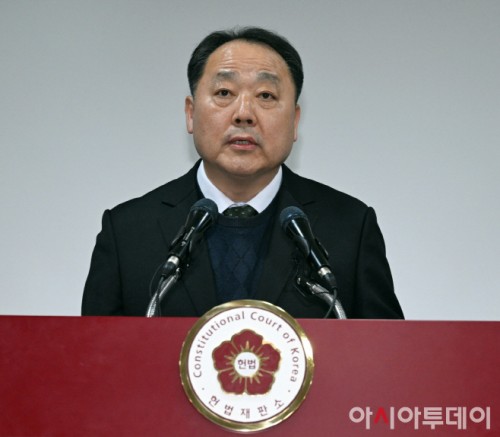 |
| Son In-hyuk, secretary general of the Constitutional Court, speaks during a press briefing on the introduction of constitutional complaints against court rulings at the Constitutional Court in Jongno District, Seoul, on March 10. / Song Eui-ju |
The Constitutional Court of Korea has begun preparations for the introduction of constitutional complaints against court rulings, emphasizing that the system is not intended to function as a fourth level of trial but as a constitutional review.
At a press briefing in Seoul on March 10, Constitutional Court Secretary General Son In-hyuk explained that constitutional complaints have traditionally served to protect citizens’ fundamental rights from abuses of public authority and to ensure that state power remains within constitutional boundaries. However, he noted that court rulings—despite having the most direct impact on individuals’ rights—had previously been excluded from such oversight.
Son said allowing constitutional complaints against court decisions represents “a meaningful and substantial step forward in guaranteeing citizens’ fundamental rights,” adding that the court will make every effort to ensure the new system is established smoothly.
The new system will take effect immediately after the revised Constitutional Court Act is promulgated by the president and published in the official gazette. Under the law, individuals will be able to file a constitutional complaint within 30 days after a court ruling becomes final.
Complaints may also be filed against rulings finalized before the law’s implementation if certain conditions are met. These include cases where a court ruling contradicts a Constitutional Court decision, where fundamental rights were violated without following procedures required by the Constitution or law, or where a ruling clearly violates constitutional or legal provisions and infringes on basic rights.
The Constitutional Court said the targets of such complaints will be final rulings from courts of first, second, or third instance. However, because complaints filed before the exhaustion of appeals could be dismissed under the principle of subsidiarity, most cases are expected to involve final rulings by the Supreme Court.
The court anticipates a sharp increase in filings once the system is implemented. Son said that considering the current rate of appeals against court rulings—around 25 to 30 percent—the Constitutional Court expects between 10,000 and 15,000 additional constitutional complaints each year. Filings could increase further if courts issue decisions that differ from the Constitutional Court’s interpretations, allowing for repeated complaints.
The Constitutional Court stressed that constitutional complaints are different from retrials. While retrials take place within the judiciary, constitutional complaints are handled by an external constitutional body that may cancel a ruling if it finds a constitutional violation. The court may also suspend the effect of a ruling through provisional measures after weighing public and private interests.
Addressing criticism that the new system effectively introduces a “fourth trial,” Son said the Constitutional Court will only review whether a ruling violates the Constitution and does not establish a hierarchical relationship between the Constitutional Court and the Supreme Court.
“The court will only issue an order canceling the ruling in question, which reflects respect for the judiciary,” he said.
The Constitutional Court has also established a preliminary review panel dedicated to constitutional complaints, consisting of eight constitutional researchers with at least 15 years of experience. The panel will examine admissibility requirements and legal issues related to the new cases.
#constitutional court #constitutional complaint #judicial review
Copyright by Asiatoday
Most Read
-
1
Celltrion’s Omlyclo gains ground in major European..

-
2
Trump demands rates fall below 1% as Fed hikes for..

-
3
Hyundai Motor Group breaks ground on integrated st..

-
4
U.S. strikes 3 Iranian oil tankers, Iran vows reta..

-
5
Trump makes $1 trillion bet ahead of midterm elect..

-
6
Iran resumes ballistic missile production, assembl..

-
7
Samsung Electronics, Mistral AI to jointly develop..

PEOPLE







-
Address : In-Young Bldg., 34, Uisadang-daero 1-gil, Yeongdeungpo-gu, Seoul
Copyright by ASIATODAY CO., LTD. All rights resereved