



Government warns of zero tolerance for fuel price gouging
Mar 06, 2026, 10:05 am


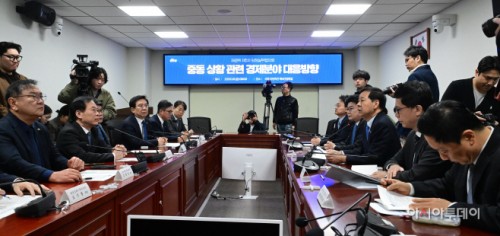 |
| Deputy Prime Minister and Minister of Economy and Finance Koo Yun-cheol speaks during a ruling party–government working-level meeting on economic responses to the Middle East crisis at the National Assembly in Seoul on March 6. / Photo by Lee Byung-hwa |
South Korea’s ruling Democratic Party and the government said on March 6 they are preparing to introduce a fuel price ceiling if necessary as global oil prices surge due to escalating tensions in the Middle East.
Speaking at a working-level party–government meeting at the National Assembly, Deputy Prime Minister and Minister of Economy and Finance Koo Yun-cheol warned that authorities would take a hard line against price gouging.
“We will respond firmly to any attempt to exploit a national crisis for economic gain,” Koo said. “If laws are violated, we will take the strongest possible measures under a zero-tolerance principle.”
Rep. Jeong Tae-ho, the ruling party’s policy coordinator on the National Assembly’s Strategy and Finance Committee, said a joint government inspection team began on-site inspections of gas stations starting March 6.
“Depending on the inspection results, the speed of introducing a fuel price ceiling by the Ministry of Trade, Industry and Energy will be determined,” Jeong said.
The government and ruling party also agreed to provide 20 trillion won in financial support to export-oriented small and medium-sized enterprises to prevent liquidity shortages caused by disruptions in global trade.
Authorities plan to review the possible release of strategic oil reserves, which currently amount to more than 208 days of supply. The government will also share phased release plans early to help private refiners prepare supply strategies.
Measures are also being considered to support companies facing higher transportation costs due to diversification of crude oil import routes.
The government is also accelerating legislative efforts aimed at stabilizing the exchange rate and addressing trade risks.
Jeong said the so-called “three exchange-rate stabilization bills,” which he introduced, are scheduled to be reviewed by a subcommittee of the Strategy and Finance Committee next week, with a goal of passing them at the National Assembly plenary session on March 19.
Lawmakers also plan to extend the deadline for benefits related to “domestic market return accounts,” which are at risk of expiring due to legislative delays.
In addition, the Special Act on Strategic Investment in the United States is expected to be finalized through a special committee review on March 9.
Meanwhile, authorities said they are continuing efforts to protect Korean citizens in the Middle East by identifying the whereabouts of company employees, sailors and travelers staying in the region.
#fuel price ceiling #oil price surge #Middle East crisis #Koo Yun-cheol #Korean government policy
Copyright by Asiatoday
Most Read
-
1
Trump shares map on social media labeling Strait o..

-
2
Kia Sportage outperforms Mazda CX-5 in German auto..

-
3
Houthis launch successive attacks on Saudi airport..

-
4
U.S. deploys carrier, 10,000 more troops to Middle..

-
5
Trump rejects Iran's offer to open Strait of Hormu..

-
6
N. Korea conducts first swarm attack drill with dr..

-
7
U.S.-China summit falls short on substance as Trum..

PEOPLE






HEADLINE NEWS
- Seoul dismisses Ukraine's claim of 'S. Korean support for Russia' as "inaccurate and inappropriate"
- S. Korea, Japan race to develop nuclear-powered submarines
- Henri Kagan, Kenso Soai win Nobel Prize in Chemistry for uncovering how mol..
- Vance says Alaska LNG cooperation will move forward with Seoul's current or..

-
Address : In-Young Bldg., 34, Uisadang-daero 1-gil, Yeongdeungpo-gu, Seoul
Copyright by ASIATODAY CO., LTD. All rights resereved