



Lee orders fuel price ceiling to curb gouging
Mar 06, 2026, 09:15 am


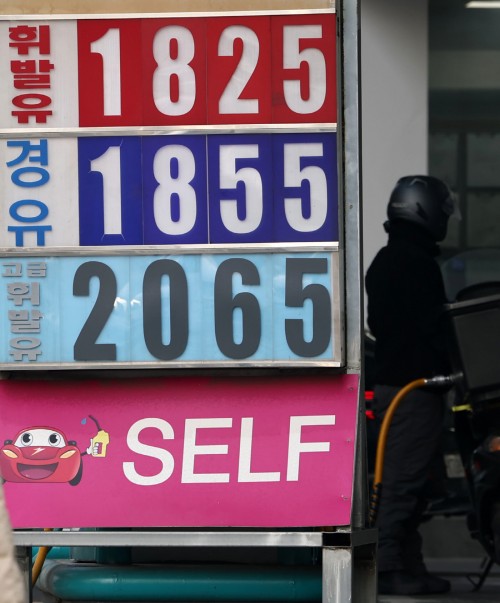 |
| Fuel prices are displayed at a gas station in Seoul on March 5 as gasoline and diesel prices surge following U.S. and Israeli airstrikes on Iran |
President Lee Jae-myung on March 5 ordered the implementation of a gasoline price ceiling to prevent excessive price hikes as global oil prices rise following escalating tensions in the Middle East.
The directive came during an emergency Cabinet meeting chaired by Lee at the presidential office, where he called for swift action to stabilize consumer prices and financial markets.
“If it is difficult to set a uniform nationwide ceiling price, please find realistic methods such as applying it by region or fuel type and designate it quickly,” Lee said.
The measure is based on Article 2 of the Price Stabilization Act, which allows the government to set maximum prices for essential goods during national emergencies, natural disasters or economic crises when necessary to protect the public and stabilize the economy.
Lee expressed concern over sudden price increases at gas stations.
“I hear that gasoline prices differ between morning, afternoon and evening, and some places raised prices by 200 won per liter,” he said. “There has not yet been a severe supply disruption, but prices are already spiking.”
Calling excessive fuel prices unacceptable, Lee instructed authorities to swiftly establish systems to crack down on price gouging. He also suggested making fuel purchase price information publicly available through websites to improve transparency.
To prevent turbulence in financial markets triggered by the Middle East crisis, Lee also ordered the rapid activation of a market stabilization program worth about 100 trillion won.
Financial Services Commission Chairman Lee Eok-won said the government plans to operate a stabilization program worth “100 trillion won plus additional resources.”
Lee also said the current crisis should be used as an opportunity to accelerate renewable energy transition and capital market reforms.
“We should turn this setback into an opportunity,” he said, adding that the government should speed up policies and legislation aimed at creating a more rational, fair, transparent and predictable market.
Meanwhile, the Cabinet approved three judicial reform bills often referred to as the “three judicial laws.” They include legislation introducing the crime of judicial distortion, a constitutional complaint system against court rulings, and a bill expanding the number of Supreme Court justices.
The laws on judicial distortion and constitutional complaints will take effect immediately upon promulgation, while the Supreme Court expansion law will be implemented in 2028, two years after its official announcement.
The Cabinet also approved a special act on administrative integration between South Jeolla Province and Gwangju, as well as a third amendment to the Commercial Act requiring companies to cancel treasury shares.
#gasoline price cap #Lee Jae-myung government #fuel price control #Korea inflation policy
Copyright by Asiatoday
Most Read
-
1
Trump shares map on social media labeling Strait o..

-
2
Kia Sportage outperforms Mazda CX-5 in German auto..

-
3
Houthis launch successive attacks on Saudi airport..

-
4
U.S. deploys carrier, 10,000 more troops to Middle..

-
5
Trump rejects Iran's offer to open Strait of Hormu..

-
6
N. Korea conducts first swarm attack drill with dr..

-
7
U.S.-China summit falls short on substance as Trum..

PEOPLE






HEADLINE NEWS
- Seoul dismisses Ukraine's claim of 'S. Korean support for Russia' as "inaccurate and inappropriate"
- S. Korea, Japan race to develop nuclear-powered submarines
- Henri Kagan, Kenso Soai win Nobel Prize in Chemistry for uncovering how mol..
- Vance says Alaska LNG cooperation will move forward with Seoul's current or..

-
Address : In-Young Bldg., 34, Uisadang-daero 1-gil, Yeongdeungpo-gu, Seoul
Copyright by ASIATODAY CO., LTD. All rights resereved