



Chip industry fears ‘all-stop’ if Middle East supply halts
Mar 05, 2026, 09:46 am


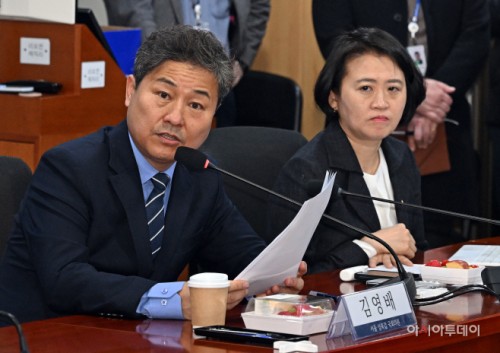 |
| Rep. Kim Young-bae of the Democratic Party speaks at an emergency meeting between the ruling party and business leaders on Middle East issues at the National Assembly in Seoul on March 5. / Song Eui-ju |
South Korea’s ruling party and major business groups warned Thursday that an escalation of the Middle East conflict could severely disrupt semiconductor production if supplies of key materials such as helium are cut off.
During an emergency meeting at the National Assembly, officials said as much as 90 percent of certain semiconductor materials — including helium — are sourced from the Middle East, particularly the United Arab Emirates.
“If procurement of these materials is disrupted, the semiconductor industry could face significant production setbacks,” said Rep. Kim Young-bae, a senior member of the Democratic Party’s Foreign Affairs and Unification Committee.
Industry leaders also expressed concerns that rising oil prices and electricity costs could weaken the global competitiveness of Korean chipmakers.
Another major concern is a potential drop in global semiconductor demand if planned artificial intelligence data center projects in the Middle East are delayed.
According to lawmakers, around 7–8 gigawatts of data center capacity — roughly one-fifth of the world’s planned 40 GW — is scheduled to be built in the Middle East. If the projects are postponed due to regional instability, chip exports could be directly affected.
Logistics costs could also surge if shipping through the Strait of Hormuz is disrupted.
“A rise in oil prices will likely lead to higher electricity costs in Korea, which will inevitably increase semiconductor production costs,” Kim said. “This could seriously undermine price competitiveness.”
Business leaders urged the government to prepare comprehensive contingency plans in case the crisis worsens.
Kim Chang-beom, vice chairman of the Korea Enterprises Federation, said the private sector is not reacting to an immediate shock but preparing for worst-case scenarios.
“We need to develop detailed scenarios analyzing how oil or LNG supply disruptions could affect different industries over time,” he said. “Government and businesses should work together to prepare countermeasures.”
The Democratic Party said concerns raised by industry leaders at the meeting would be conveyed to the presidential office and reflected in discussions at upcoming Cabinet meetings, while relevant parliamentary committees consider additional policy responses.
#semiconductor supply chain #helium supply risk #Middle East crisis #Korea semiconductor industry #Hormuz Strait risk
Copyright by Asiatoday
Most Read
-
1
Trump shares map on social media labeling Strait o..

-
2
Kia Sportage outperforms Mazda CX-5 in German auto..

-
3
Houthis launch successive attacks on Saudi airport..

-
4
U.S. deploys carrier, 10,000 more troops to Middle..

-
5
Trump rejects Iran's offer to open Strait of Hormu..

-
6
N. Korea conducts first swarm attack drill with dr..

-
7
U.S.-China summit falls short on substance as Trum..

PEOPLE






HEADLINE NEWS
- Seoul dismisses Ukraine's claim of 'S. Korean support for Russia' as "inaccurate and inappropriate"
- S. Korea, Japan race to develop nuclear-powered submarines
- Henri Kagan, Kenso Soai win Nobel Prize in Chemistry for uncovering how mol..
- Vance says Alaska LNG cooperation will move forward with Seoul's current or..

-
Address : In-Young Bldg., 34, Uisadang-daero 1-gil, Yeongdeungpo-gu, Seoul
Copyright by ASIATODAY CO., LTD. All rights resereved