



Constitutional review request emerges in Yoon appeal trial
Mar 05, 2026, 09:24 am


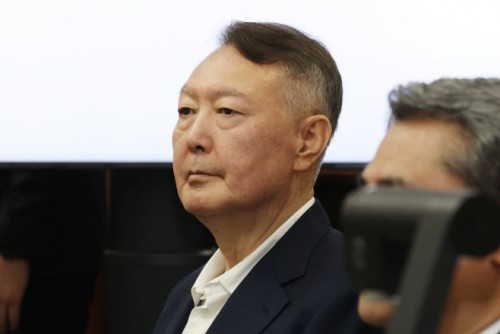 |
| Former President Yoon Suk Yeol. / Joint Press Corps |
The appeal trial in former President Yoon Suk Yeol’s case involving the alleged obstruction of an arrest attempt by the Corruption Investigation Office for High-ranking Officials entered its first hearing Tuesday, with a constitutional challenge expected to become a key variable in the proceedings.
The Seoul High Court’s Criminal Division 1, presided over by Judge Yoon Sung-sik, held the first appellate hearing for Yoon, who was sentenced to five years in prison in the first trial on charges including special obstruction of official duties.
Attention is now focused on whether Yoon’s legal team will request a constitutional review of the law that established specialized court panels dedicated to handling insurrection-related cases.
If the court accepts the request and refers the matter to the Constitutional Court of Korea, the main trial proceedings would be suspended until the court rules on the law’s constitutionality.
The law, which took effect in January, created dedicated panels within the Seoul Central District Court and the Seoul High Court to handle cases involving insurrection, treason, or related crimes deemed to be of national importance. Under the system, two panels were designated in each court.
Because the special prosecutor law related to the insurrection investigation requires the appellate ruling to be delivered within three months of the first trial verdict, the appeal is expected to conclude around May.
However, a constitutional review request by Yoon’s legal team could significantly delay the process. If the Constitutional Court takes time to deliberate, Yoon could be released once the six-month detention limit expires.
Yoon’s lawyers had previously criticized the law when it passed the National Assembly last December, saying they would seek constitutional review and oppose what they called a violation of constitutional principles.
Debate over the constitutionality of the special court panels has persisted since the legislation was first discussed. Critics argue that establishing separate panels for specific crimes and reassigning ongoing cases could infringe upon judicial independence and the right to a fair trial.
Some legal experts, however, believe the chances of the Constitutional Court striking down the law are relatively low. They note that the designation of the panels followed procedures including judicial council discussions and committee decisions on case assignments, and that individual cases were distributed through a random electronic system.
Others argue that constitutional concerns remain unresolved. They claim the law could be viewed as a “dispositional statute” targeting specific cases rather than a general law applied broadly.
Cha Jin-a, a professor at Korea University’s law school, said the measure resembles a special tribunal created after the fact to deal with particular incidents.
“Although it formally appears to apply to an unspecified number of cases and individuals, insurrection or treason cases do not occur frequently enough to justify a permanent specialized court,” she said, adding that questions about the Constitutional Court’s political neutrality and independence could influence the outcome of the review.
#Yoon Suk Yeol trial #arrest obstruction case #constitutional review request #special court panel
Copyright by Asiatoday
Most Read
-
1
Celltrion nears additional contract with major U.S..

-
2
Putin proposes trilateral U.S.-China-Russia summit..

-
3
U.S. weighs dropping MOAB, world's most powerful n..

-
4
"Aren't those foreigners on welfare?": M..

-
5
Attention centers on APEC for possible Trump-Xi-Pu..

-
6
Saudi Arabia, Iran hold first diplomatic talks to..

-
7
U.S., Israel plan to resume strikes on Iran after..

PEOPLE






-
Address : In-Young Bldg., 34, Uisadang-daero 1-gil, Yeongdeungpo-gu, Seoul
Copyright by ASIATODAY CO., LTD. All rights resereved