



Ruling party pushes sweeping court reform
Mar 03, 2026, 09:22 am


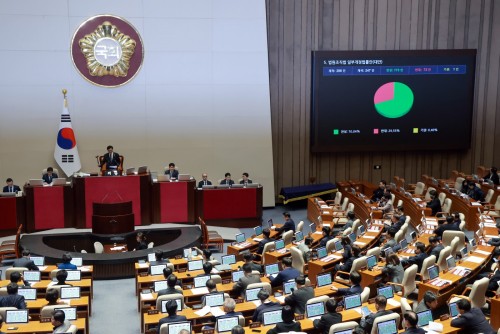 |
| Lawmakers vote on the amendment to the Court Organization Act, which expands the number of Supreme Court justices, during a plenary session of the National Assembly on Feb. 28. The bill passed with 173 votes in favor, 73 against and one abstention. / Yonhap |
South Korea’s National Assembly has passed a package of judicial reform bills, marking the first comprehensive overhaul of the country’s judicial system since the 1987 constitutional revision.
The so-called “three major judicial reform bills” — the introduction of a distortion of law offense, a constitutional complaint system against final court rulings, and an expansion of Supreme Court justices — were approved during plenary sessions held from Feb. 26 to 28, led by the ruling party.
Once promulgated after Cabinet review, the revised Criminal Act will allow criminal punishment of judges and prosecutors found to have distorted the law during investigations or trials. The amended Constitutional Court Act introduces a system enabling individuals to file constitutional complaints against finalized Supreme Court rulings. Meanwhile, revisions to the Court Organization Act will increase the number of Supreme Court justices from 14 to 26.
The ruling party made last-minute revisions to narrow the scope of the distortion of law offense to criminal cases and clarify certain elements of the crime. However, critics argue that the provisions remain vague and could trigger a surge of complaints and lawsuits against judges and prosecutors.
Concerns have also been raised over the new constitutional complaint system. Legal experts warn that litigants who lose at the Supreme Court may effectively seek a second round of review at the Constitutional Court of Korea, potentially worsening case backlogs and creating what some describe as “litigation overload.”
The reform could also alter the balance between the Supreme Court and the Constitutional Court. Critics argue that shifting from the current horizontal dual structure to a more vertical framework risks undermining the principles of separation of powers and mutual checks and balances, potentially concentrating excessive authority in the Constitutional Court.
The expansion of Supreme Court justices — the final piece of the reform — will take effect two years after promulgation, with four additional justices appointed each year over three years. President Lee Jae-myung would be able to appoint 22 of the 26 justices during his term, a point that has fueled opposition criticism.
Opposition parties have denounced the move as a bid to fill the court with politically aligned figures, warning that it could erode judicial neutrality.
A constitutional law expert noted that the Constitution requires National Assembly consent for Supreme Court appointments to ensure political balance and oversight. “If confirmation hearings become a mere formality under a dominant ruling party, public trust in the judiciary’s political neutrality could be significantly shaken,” the expert said.
Another major concern is the potential weakening of lower courts. Each Supreme Court justice is currently supported by an average of 8.4 research judges. Expanding the bench by 12 justices could require reallocating roughly 100 experienced judges — typically senior judges with more than 14 years of experience — from first- and second-instance courts to the Supreme Court.
“A structure where pillars are removed from the first and second floors to support the top floor of a building,” a criminal law attorney said. “Thorough fact-finding at lower courts is the starting point for protecting citizens’ rights.”
#judicial reform bills #distortion of law offense #constitutional complaint #Supreme Court justices expansion #Lee Jae-myung
Copyright by Asiatoday
Most Read
-
1
Celltrion nears additional contract with major U.S..

-
2
Putin proposes trilateral U.S.-China-Russia summit..

-
3
U.S. weighs dropping MOAB, world's most powerful n..

-
4
"Aren't those foreigners on welfare?": M..

-
5
Attention centers on APEC for possible Trump-Xi-Pu..

-
6
Saudi Arabia, Iran hold first diplomatic talks to..

-
7
U.S., Israel plan to resume strikes on Iran after..

PEOPLE







-
Address : In-Young Bldg., 34, Uisadang-daero 1-gil, Yeongdeungpo-gu, Seoul
Copyright by ASIATODAY CO., LTD. All rights resereved