



Ruling party pushes judicial reform bill through
Feb 27, 2026, 07:29 am


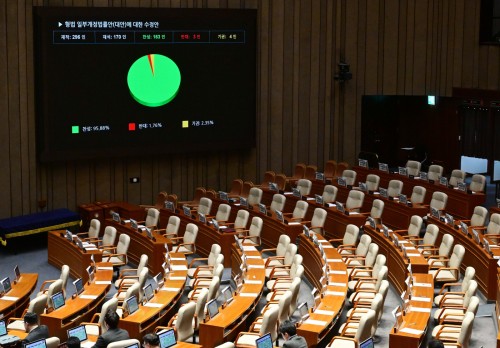 |
| A revision bill to the Criminal Act, including the newly introduced “distortion of law” offense, is passed during a plenary session of the National Assembly on Feb. 26, with People Power Party lawmakers boycotting the vote. / Photo by Lee Byung-hwa |
A controversial bill introducing a new “distortion of law” offense, one of three major judicial reform measures backed by the Democratic Party of Korea, passed the National Assembly on Wednesday despite fierce opposition protests and concerns from the judiciary.
The amendment to the Criminal Act was approved in a plenary session with 163 votes in favor, three against and four abstentions out of 170 lawmakers present. Lawmakers from the People Power Party boycotted the vote.
The bill stipulates that judges or prosecutors who intentionally distort the law or fabricate facts in indictments or trials can face up to 10 years in prison. The legislation was put to a vote after the opposition’s filibuster was ended through a motion to close debate.
The measure has been at the center of controversy among the ruling party’s reform agenda. Critics have questioned its constitutionality, the vagueness of its definitions and the potential chilling effect on judicial independence.
The People Power Party argued that the existing three-tier trial system already provides sufficient review mechanisms. “This is an attempt to pressure judges and prosecutors with criminal punishment and turn core judicial acts such as indictment and trial into subjects of investigation,” a party spokesperson said.
On Tuesday, chief judges from courts nationwide expressed regret that the bill was brought to a plenary vote without sufficient deliberation. They warned that the abstract elements of the offense could broaden the scope of punishment and lead to excessive complaints and accusations.
In response to such concerns, the Democratic Party revised the bill prior to the vote, limiting its application to criminal cases and clarifying certain provisions to reduce potential constitutional issues. Some party lawmakers, however, reportedly raised concerns that the revisions weakened the bill’s effectiveness.
Immediately after the bill’s passage, the Democratic Party moved to introduce the so-called “trial appeal” bill, an amendment to the Constitutional Court Act that would allow individuals to challenge court rulings directly to the Constitutional Court. The party also plans to push forward a bill to increase the number of Supreme Court justices by amending the Court Organization Act.
Cheon Jun-ho, senior deputy floor leader of the Democratic Party, said the judiciary had failed to seek ways to restore public trust and instead focused on avoiding reform. “We can no longer treat the judiciary as a sacred domain,” he said, adding that the party intends to process the three judicial reform bills “on a daily basis.”
The People Power Party denounced the move as a “modern-day judicial destruction,” accusing the ruling party of “carving up judicial order with the blade of legislation.”
#distortion of law offense #Democratic Party of Korea #People Power Party #National Assembly #judicial reform bills
Copyright by Asiatoday
Most Read
-
1
Trump shares map on social media labeling Strait o..

-
2
Kia Sportage outperforms Mazda CX-5 in German auto..

-
3
Houthis launch successive attacks on Saudi airport..

-
4
U.S. deploys carrier, 10,000 more troops to Middle..

-
5
Trump rejects Iran's offer to open Strait of Hormu..

-
6
N. Korea conducts first swarm attack drill with dr..

-
7
U.S.-China summit falls short on substance as Trum..

PEOPLE






HEADLINE NEWS
- Seoul dismisses Ukraine's claim of 'S. Korean support for Russia' as "inaccurate and inappropriate"
- S. Korea, Japan race to develop nuclear-powered submarines
- Henri Kagan, Kenso Soai win Nobel Prize in Chemistry for uncovering how mol..
- Vance says Alaska LNG cooperation will move forward with Seoul's current or..

-
Address : In-Young Bldg., 34, Uisadang-daero 1-gil, Yeongdeungpo-gu, Seoul
Copyright by ASIATODAY CO., LTD. All rights resereved