



Cash-rich SK hynix readies AI expansion
Feb 27, 2026, 07:29 am


 |
| SK hynix headquarters in Icheon, Gyeonggi Province. / Photo by AsiaToday |
SK hynix has secured some 30 trillion won ($22 billion) in cash and short-term financial instruments, reinforcing its financial firepower as it accelerates investments in artificial intelligence semiconductors, facilities and research and development.
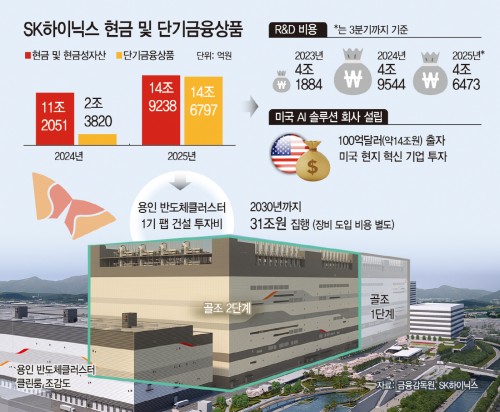
According to data released by the Financial Supervisory Service on Wednesday, the chipmaker held 14.92 trillion won in cash and 14.68 trillion won in short-term financial products as of the end of last year. Cash holdings rose 33 percent on-year, while short-term financial products surged 516 percent.
Short-term financial instruments, typically with maturities of less than one year, can be quickly converted into cash, signaling the company’s intent to secure liquidity for imminent large-scale investments.
In contrast, less liquid assets such as investment properties remained almost unchanged at around 200 million won, underscoring the company’s focus on readily deployable capital.
SK hynix plans to invest more than 30 trillion won in the Yongin semiconductor cluster by 2030. Of that, about 21.6 trillion won will be spent on the first fabrication plant within the cluster. The total project cost is estimated at roughly 31 trillion won.
The company earlier said it would “significantly” increase capital expenditures this year, citing expectations that the AI-driven semiconductor boom will continue for the foreseeable future. Expanding production capacity early and establishing a stable supply system have become urgent priorities.
“We aim to expand production capacity at an early stage and build a foundation to supply products stably when customers need them,” the company said.
Beyond domestic investment, SK hynix has also established a U.S. subsidiary to spearhead AI-related investments and solution businesses. The company plans to inject $10 billion (about 14.5 trillion won) into the initiative.
Research and development spending is also on the rise. SK hynix recorded 4.95 trillion won in R&D expenses in 2024, up 18.3 percent from a year earlier. Through the third quarter of last year alone, the company had already spent 4.64 trillion won, equivalent to 93.8 percent of the previous year’s total, indicating that annual R&D spending is likely to surpass prior levels.
Key development projects include HBM4, widely expected to become the mainstream product in the high bandwidth memory market in the near future.
The company also announced that it has begun standardization work on HBF, a next-generation memory solution often dubbed the “second HBM.” In collaboration with U.S.-based SanDisk, SK hynix formed a dedicated workstream under the Open Compute Project to establish HBF as an industry standard.
As AI services expand, existing memory architectures face limitations in simultaneously meeting large-scale data processing and power efficiency requirements during inference stages. HBF is seen as a potential alternative to overcome these constraints, with the memory market expected to expand significantly around 2030.
With aggressive capital expenditures, surging R&D outlays and overseas AI investments, SK hynix appears well-positioned to extend its footprint in the rapidly evolving AI semiconductor landscape.
#SK hynix #AI semiconductor #HBM4 #HBF #Yongin semiconductor cluster
Copyright by Asiatoday
Most Read
-
1
Kia Sportage outperforms Mazda CX-5 in German auto..

-
2
Houthis launch successive attacks on Saudi airport..

-
3
Saudi Arabia, Iran hold first diplomatic talks to..

-
4
U.S. deploys carrier, 10,000 more troops to Middle..

-
5
Saudi airport in Riyadh struck again, leaving at l..

-
6
Putin's ally visits China on the 8th ahead of APEC..

-
7
Chinese military support and training center opens..

PEOPLE






HEADLINE NEWS

-
Address : In-Young Bldg., 34, Uisadang-daero 1-gil, Yeongdeungpo-gu, Seoul
Copyright by ASIATODAY CO., LTD. All rights resereved