



Hardline standoff deepens before June elections
Feb 26, 2026, 07:52 am


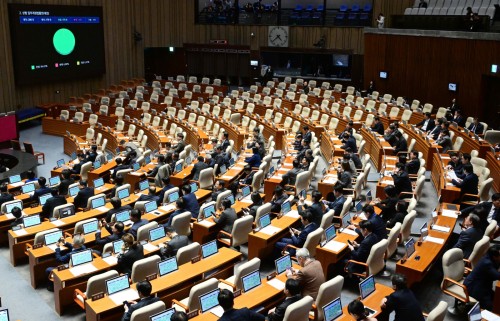 |
| A revision to the Commercial Act is passed at a plenary session of the National Assembly on Feb. 25, with 175 votes in favor and one abstention out of 176 lawmakers present, as People Power Party members boycott the vote. /Lee Byung-hwa |
With the June 3 local elections just three months away, political tensions between the ruling Democratic Party of Korea and the opposition People Power Party are intensifying, raising concerns that livelihood and reform agendas are being sidelined.
The Democratic Party has pushed forward a package of controversial judicial reform bills — including measures on “judicial distortion,” constitutional complaints against court rulings and an increase in the number of Supreme Court justices — framing them as part of its broader reform drive.
In response, the People Power Party has mounted a fierce resistance, launching filibusters against all bills submitted to the plenary session of the February extraordinary National Assembly.
The Democratic Party has been accused by the opposition of pursuing a “legislative blitz,” using its majority to unilaterally advance key bills such as the third revision of the Commercial Act and other livelihood-related legislation.
The People Power Party, meanwhile, has declared a boycott of all standing committee meetings in an effort to block what it calls one-sided legislative action.
On Feb. 25, even a full meeting of the Science, ICT, Broadcasting and Communications Committee proceeded without participation from People Power Party lawmakers.
The Democratic Party has signaled that it may convene standing committees independently and reconsider the allocation of committee chairmanships if the opposition continues its resistance.
Floor leader Han Byung-do said the party would “break through the People Power Party’s hostage-taking of livelihood issues,” even if it means revising the National Assembly Act again to address filibuster procedures.
Observers say the hardline standoff reflects election strategies on both sides.
The Democratic Party aims to capitalize on a reform narrative and support the policy agenda of the Lee Jae-myung administration, including capital market advancement, real estate normalization and balanced national development.
The People Power Party, in contrast, has framed its strategy around “blocking legislative overreach,” portraying itself as a check on the ruling party’s dominance.
With more than 100 bills currently pending in the National Assembly, analysts warn that prolonged confrontation could push urgent livelihood and reform measures to the back burner.
As campaigning intensifies, many expect the “hardline versus hardline” dynamic to persist through the local elections — further deepening partisan divides while legislative productivity stalls.
#Democratic Party of Korea #People Power Party #filibuster #judicial reform bills #Commercial Act revision
Copyright by Asiatoday
Most Read
-
1
Trump shares map on social media labeling Strait o..

-
2
Kia Sportage outperforms Mazda CX-5 in German auto..

-
3
Houthis launch successive attacks on Saudi airport..

-
4
U.S. deploys carrier, 10,000 more troops to Middle..

-
5
Trump rejects Iran's offer to open Strait of Hormu..

-
6
N. Korea conducts first swarm attack drill with dr..

-
7
U.S.-China summit falls short on substance as Trum..

PEOPLE






HEADLINE NEWS
- Seoul dismisses Ukraine's claim of 'S. Korean support for Russia' as "inaccurate and inappropriate"
- S. Korea, Japan race to develop nuclear-powered submarines
- Henri Kagan, Kenso Soai win Nobel Prize in Chemistry for uncovering how mol..
- Vance says Alaska LNG cooperation will move forward with Seoul's current or..

-
Address : In-Young Bldg., 34, Uisadang-daero 1-gil, Yeongdeungpo-gu, Seoul
Copyright by ASIATODAY CO., LTD. All rights resereved