



Ruling bloc pushes buyback cancellation law through
Feb 26, 2026, 07:52 am


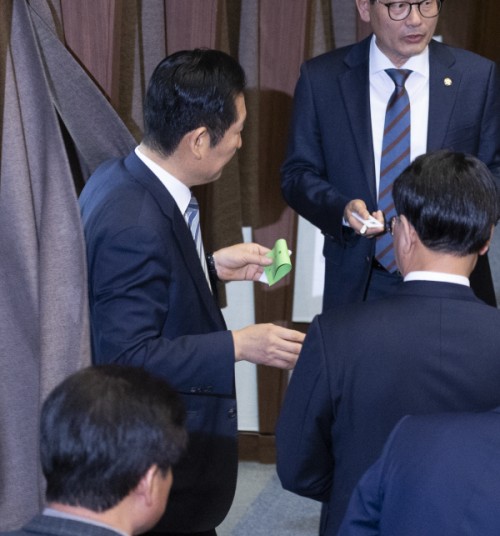 |
| Democratic Party leader Chung Cheong-rae casts his vote to end a filibuster on the third revision of the Commercial Act during a plenary session of the National Assembly on Feb. 25. /Yonhap |
A third revision to the Commercial Act, mandating in principle the cancellation of treasury shares held by companies, passed the National Assembly on Feb. 25, led by the ruling bloc including the Democratic Party of Korea.
The amendment was approved in a plenary session with 175 votes in favor and one abstention out of 176 lawmakers present.
The core provision requires companies that acquire treasury shares to cancel them within one year in principle.
The bill was first introduced in late November by Rep. Oh Ki-hyung of the Democratic Party’s K Capital Market Special Committee and cleared the Legislation and Judiciary Committee on Feb. 23 after months of delay amid partisan disputes.
Exceptions are permitted in cases such as employee compensation or employee stock ownership plans, provided that all directors sign and seal a retention and disposal plan, which must then be approved annually at a shareholders’ meeting.
For companies subject to foreign investment restrictions under relevant laws — such as the Telecommunications Business Act — treasury shares must, in principle, be disposed of within three years from the law’s enforcement date to ensure regulatory compliance.
The People Power Party opposed the bill, arguing that it could weaken companies’ minimum defensive tools.
“The serious problem with this amendment is that it may be designed in a way that directly weakens the minimum means by which companies can protect themselves,” the party said during debate.
In response, Democratic Party leader Chung Cheong-rae and other ruling party lawmakers defended the measure, arguing that continued tolerance of treasury share retention as a management control defense tactic would undermine efforts to advance the capital market.
They said the amendment is intended to enhance shareholder value and improve transparency in the stock market, amid broader efforts to strengthen Korea’s capital market competitiveness.
#Democratic Party of Korea #Chung Cheong-rae #Commercial Act revision #treasury shares
Copyright by Asiatoday
Most Read
-
1
Trump shares map on social media labeling Strait o..

-
2
Kia Sportage outperforms Mazda CX-5 in German auto..

-
3
Houthis launch successive attacks on Saudi airport..

-
4
U.S. deploys carrier, 10,000 more troops to Middle..

-
5
Trump rejects Iran's offer to open Strait of Hormu..

-
6
N. Korea conducts first swarm attack drill with dr..

-
7
U.S.-China summit falls short on substance as Trum..

PEOPLE






HEADLINE NEWS
- Seoul dismisses Ukraine's claim of 'S. Korean support for Russia' as "inaccurate and inappropriate"
- S. Korea, Japan race to develop nuclear-powered submarines
- Henri Kagan, Kenso Soai win Nobel Prize in Chemistry for uncovering how mol..
- Vance says Alaska LNG cooperation will move forward with Seoul's current or..

-
Address : In-Young Bldg., 34, Uisadang-daero 1-gil, Yeongdeungpo-gu, Seoul
Copyright by ASIATODAY CO., LTD. All rights resereved