



Hyundai backs submarine bid with hydrogen plan
Feb 26, 2026, 07:52 am


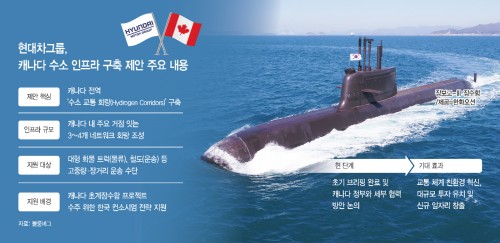 |
Hyundai Motor Group has proposed building hydrogen fuel cell infrastructure across Canada to support a Korean consortium’s bid for the country’s patrol submarine project, according to a Bloomberg report published on Feb. 24.
The proposed project, known as the Canadian Patrol Submarine Project (CPSP), is valued at up to 60 trillion won (approximately C$20 billion–C$24 billion) and is considered one of the largest military procurement programs in Canadian history.
Bloomberg cited Glenn Copeland, CEO of Hanwha Ocean Canada, as saying that Hyundai recently briefed Canadian officials on an early-stage hydrogen infrastructure plan during their visit to Korea.
Under the proposal, Hyundai would establish three to four hydrogen transport corridors across Canada, building hydrogen refueling and fuel cell facilities to support long-distance rail and heavy-duty truck operations.
“If realized, it would represent a significant level of investment,” Copeland said, noting that the initiative could bring “transformational change” to major transportation corridors, whether for freight trucks or trains.
He added, however, that the plan has not been finalized and discussions between Hyundai and the Canadian government are ongoing.
Bloomberg noted that hydrogen fuel cells, which allow rapid refueling and long-range travel, align well with Canada’s vast geography and abundant clean power resources.
The Canadian government plans to acquire up to 12 submarines. The final contenders include a consortium of Hanwha Ocean and HD Hyundai Heavy Industries from Korea, and Germany-Norway’s ThyssenKrupp Marine Systems (TKMS).
The project, estimated at C$20 billion–C$24 billion, is expected to prioritize domestic investment and job creation, according to Bloomberg.
Copeland, a former Canadian naval officer who served 22 years before retiring as a lieutenant colonel, previously worked at Lockheed Martin Canada overseeing the Halifax-class modernization program. He was recently appointed to lead Hanwha Ocean’s Canadian subsidiary for the submarine bid.
South Korea’s Ministry of Trade, Industry and Energy, which is engaged in negotiations with Canada, said no specific investment scale or framework has been finalized regarding Hyundai’s potential participation in hydrogen fuel cell projects.
An official said that if cooperation proceeds, it is more likely to focus on technology collaboration rather than large-scale capital investment.
Hyundai also stated that while it has discussed broad hydrogen cooperation with Canada, the matter has not advanced to a concrete commercialization stage.
In a statement, the company said it is “reviewing various cooperation opportunities with Canada, including potential collaboration in the hydrogen sector.”
One key variable is Canada’s reported interest in establishing a local automobile manufacturing plant. Bloomberg said Canada has recently discussed automotive manufacturing cooperation with both Korea and Germany. A spokesperson for Industry Minister Mélanie Joly said Canada already has strengths in automobile production and is exploring capacity expansion. Hyundai, however, views such a move as challenging under current market conditions.
Bloomberg reported that Hanwha Ocean has signed around 15 memorandums of understanding with Canadian companies and pledged investment and job creation if it wins the contract.
These include a potential investment of up to C$345 million in Algoma Steel Group to explore steel facility development and plans to establish a shipbuilding training hub in Hamilton, Ontario.
Hanwha is expected to submit its final proposal by March 2, with Copeland anticipating a decision in June. Additional investment announcements in aerospace, mining and natural gas sectors may also follow.
“This project goes beyond hardware — it is about geopolitics and trade,” Copeland said. “It serves as a gateway to building relationships in the Indo-Pacific region.”
TKMS has proposed a variant of its Type 212 submarine, while Hanwha Ocean has put forward its KSS-III submarine, projecting the first delivery by 2032 and emphasizing reduced maintenance burdens and immediate operational readiness.
Copeland estimated that the program could support approximately 25,000 jobs annually starting in 2027–28, potentially increasing to 40,000 jobs in the early 2030s.
#Hyundai Motor Group #Hanwha Ocean #Canada patrol submarine project #CPSP
Copyright by Asiatoday
Most Read
-
1
Kia Sportage outperforms Mazda CX-5 in German auto..

-
2
Houthis launch successive attacks on Saudi airport..

-
3
Saudi Arabia, Iran hold first diplomatic talks to..

-
4
U.S. deploys carrier, 10,000 more troops to Middle..

-
5
Saudi airport in Riyadh struck again, leaving at l..

-
6
Putin's ally visits China on the 8th ahead of APEC..

-
7
Chinese military support and training center opens..

PEOPLE






HEADLINE NEWS

-
Address : In-Young Bldg., 34, Uisadang-daero 1-gil, Yeongdeungpo-gu, Seoul
Copyright by ASIATODAY CO., LTD. All rights resereved