



US supreme court ruling reshapes global trade
Feb 24, 2026, 07:26 am


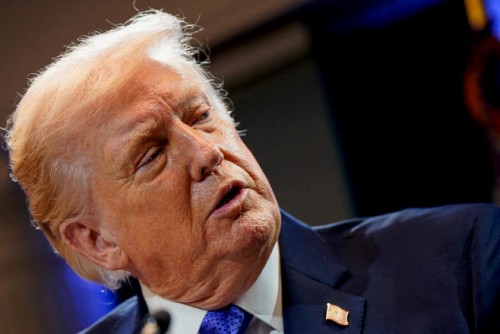 |
| U.S. President Donald Trump / Reuters-Yonhap News |
The global trade landscape is shifting rapidly after the U.S. Supreme Court blocked President Donald Trump’s global tariff measures, opening the door for some of the hardest-hit countries to emerge as unexpected beneficiaries.
According to Bloomberg on Feb. 22, the Supreme Court ruled that tariffs imposed by Trump under the International Emergency Economic Powers Act (IEEPA) were unlawful. As a result, countries including China, India and Brazil are expected to see lower tariff rates applied to their exports to the United States.
Trump later announced a plan to impose a uniform 15% tariff on imports from around the world. Bloomberg Economics estimated that under such a system, the average effective tariff rate would fall to around 12%, the lowest level since the “Liberation Day” tariff announcement in April.
Asia’s burden is also projected to ease somewhat. Morgan Stanley forecast that Asia’s weighted average tariff rate would decline from 20% to 17%. In particular, average tariffs on Chinese goods are expected to fall from 32% to 24%. However, there are signs that the Trump administration may reintroduce industry-specific and country-specific tariffs, raising the possibility that any relief could be temporary.
The proposed 15% blanket tariff would effectively reset competitive conditions among U.S. trading partners. Following the court ruling, China — which had faced an additional 10% fentanyl-related tariff — would see its export burden reduced. By contrast, the United Kingdom and Australia, which had secured relatively low 10% tariffs under a reciprocal framework, would now face comparatively higher costs. Japan, which had enjoyed a competitive edge under a 15% tariff rate, would also lose that advantage.
Senior U.S. officials have urged key partners such as the European Union and Japan to uphold existing negotiated agreements, while signaling their intention to maintain a one-year trade truce with China.
Jamieson Greer, the U.S. Trade Representative, said in an interview with Fox News, “We want to ensure that China is complying with the agreement,” adding that Beijing “must continue to purchase the products it committed to.”
Canada and Mexico, which were also subject to fentanyl-related tariffs, would see that burden lifted following the ruling. If exemptions under the United States-Mexico-Canada Agreement (USMCA) remain in place, the two countries could find themselves in a highly advantageous position.
At the same time, the new 15% tariff framework would increase pressure on countries that had previously benefited from the 10% rate, including Australia and the United Kingdom. Meanwhile, nations such as Japan that had gained relative competitiveness under the earlier 15% rate would see that benefit erased.
Although the ruling introduces fresh uncertainty, some analysts believe the short-term impact will be limited, citing the resilience of global trade over the past year and the relatively modest overall change in average tariff levels.
Goldman Sachs estimated that the combined effect of the Supreme Court ruling and the newly announced “Section 122 tariffs” would reduce the increase in the effective tariff rate since early 2025 from just over 10 percentage points to about 9 percentage points.
Experts said that “imports from countries where tariffs have recently fallen significantly are likely to increase in the coming months,” but added that inventory buildup, stronger consumption, reduced transshipment trade and declining imports from countries facing higher tariffs would likely offset each other, limiting the overall impact on gross domestic product.
#Donald Trump #US supreme court #tariffs #China #India
Copyright by Asiatoday
Most Read
-
1
Trump shares map on social media labeling Strait o..

-
2
Kia Sportage outperforms Mazda CX-5 in German auto..

-
3
Houthis launch successive attacks on Saudi airport..

-
4
U.S. deploys carrier, 10,000 more troops to Middle..

-
5
Trump rejects Iran's offer to open Strait of Hormu..

-
6
N. Korea conducts first swarm attack drill with dr..

-
7
U.S.-China summit falls short on substance as Trum..

PEOPLE





HEADLINE NEWS
- Seoul dismisses Ukraine's claim of 'S. Korean support for Russia' as "inaccurate and inappropriate"
- S. Korea, Japan race to develop nuclear-powered submarines
- Henri Kagan, Kenso Soai win Nobel Prize in Chemistry for uncovering how mol..
- Vance says Alaska LNG cooperation will move forward with Seoul's current or..

-
Address : In-Young Bldg., 34, Uisadang-daero 1-gil, Yeongdeungpo-gu, Seoul
Copyright by ASIATODAY CO., LTD. All rights resereved