



Merger row resurfaces in ruling party after memorial
Feb 02, 2026, 07:59 am


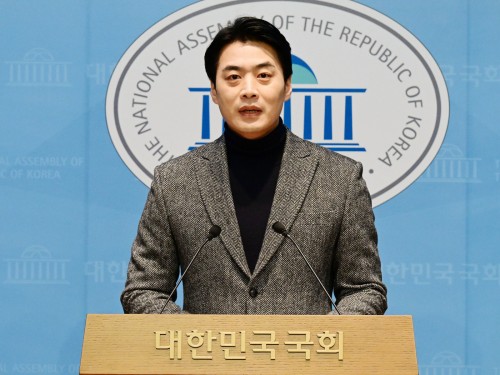 |
| Rep. Han Jun-ho of the Democratic Party of Korea speaks during a press conference at the National Assembly on Feb. 1, calling on party leader Chung Cheong-rae to withdraw a proposal for a merger with the Cho Kuk Innovation Party. / Lee Byung-hwa |
Factional tensions have resurfaced within South Korea’s ruling party following the conclusion of the memorial period for former Prime Minister Lee Hae-chan, as internal divisions reemerge over a proposed merger with the Cho Kuk Innovation Party.
The dispute centers on an initiative pushed by party leader Chung Cheong-rae to pursue a merger with the Innovation Party. Members of the pro–Lee Jae-myung faction have publicly voiced opposition, raising concerns that the issue could deepen internal rifts ahead of the February extraordinary session of the National Assembly.
Han Jun-ho, a lawmaker aligned with President Lee Jae-myung, called on Chung to withdraw the proposal, warning that unity achieved without sufficient deliberation could instead sow the seeds of further division.
“Integration without thorough discussion will never be completed as true unity,” Han said at a press conference. “It risks becoming the starting point of yet another split.”
Han also questioned the rationale behind the proposed merger, asking whether there was any objective evidence that it would help secure victories in nationwide local elections. He argued that various forms of cooperation — including candidate coordination or policy alliances — remain available, and criticized the lack of explanation for why a full merger was necessary, and why it should be pursued now. He urged party leaders to shelve the merger plan and focus instead on livelihood-related and reform legislation to support the success of the Lee administration.
Party leaders moved to contain the fallout while acknowledging the need for procedural discussion. Lee Sung-yoon, a senior party official, said the merger debate itself marked the beginning of an era of member-driven party governance. Emphasizing that party unity has long been a core principle of President Lee, he proposed opening a forum for party members to discuss and collectively decide the issue.
Despite efforts to calm tensions, signs of lingering discord remain. Recent Telegram messages exchanged between Cabinet members and party lawmakers, reportedly referencing alleged “backroom deals” and “division of stakes,” have fueled mistrust within the party. The party’s freshman lawmakers’ group is scheduled to hold a meeting on Sunday to gather collective views on the merger plan.
Coordination with the Innovation Party also presents challenges. Park Byeong-eon, spokesperson for the Innovation Party, criticized remarks by Democratic Party Supreme Council member Lee Eon-ju questioning the validity of land public ownership principles, calling them “deeply regrettable” and signaling that the party would issue a formal response.
Lee Eon-ju had earlier argued on social media that the policy conflicts with constitutional protections of private property, the Lee administration’s “centrist pragmatism,” and recent housing supply measures. She also warned that merging with a party whose policies diverge from the asset-building aspirations of younger generations could undermine the president’s governing agenda, calling for the merger proposal to be withdrawn.
Meanwhile, the Democratic Party has continued its offensive against the opposition despite internal turmoil. Floor spokesperson Kim Hyun-jung defended the government’s Jan. 29 housing supply measures, accusing the People Power Party of focusing solely on “mockery and obstruction” rather than constructive debate.
#Lee Hae-chan memorial #Democratic Party of Korea #party merger #Cho Kuk Innovation Party #factional conflict
Copyright by Asiatoday
Most Read
-
1
Trump shares map on social media labeling Strait o..

-
2
Kia Sportage outperforms Mazda CX-5 in German auto..

-
3
Houthis launch successive attacks on Saudi airport..

-
4
U.S. deploys carrier, 10,000 more troops to Middle..

-
5
Trump rejects Iran's offer to open Strait of Hormu..

-
6
N. Korea conducts first swarm attack drill with dr..

-
7
U.S.-China summit falls short on substance as Trum..

PEOPLE




HEADLINE NEWS
- Seoul dismisses Ukraine's claim of 'S. Korean support for Russia' as "inaccurate and inappropriate"
- S. Korea, Japan race to develop nuclear-powered submarines
- Henri Kagan, Kenso Soai win Nobel Prize in Chemistry for uncovering how mol..
- Vance says Alaska LNG cooperation will move forward with Seoul's current or..

-
Address : In-Young Bldg., 34, Uisadang-daero 1-gil, Yeongdeungpo-gu, Seoul
Copyright by ASIATODAY CO., LTD. All rights resereved