



Ruling party targets late Feb passage of US investment bill
Feb 02, 2026, 07:58 am


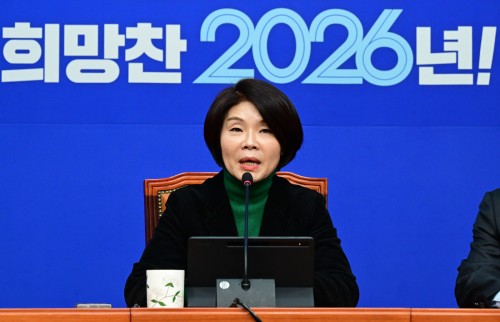 |
| Han Jeong-ae, policy chief of the Democratic Party of Korea, speaks during a press briefing on policy issues at the National Assembly on Feb. 1. / Lee Byung-hwa |
South Korea’s ruling party said Saturday it aims to pass a special bill on US-bound investment by late February to early March, accelerating legislative efforts to counter mounting tariff pressure from Washington.
Han Jeong-ae, policy chief of the Democratic Party of Korea, said at a press briefing at the National Assembly that the party would seek to process the special US investment bill during the February extraordinary session.
“Once the bill is placed on the agenda of the National Assembly’s Strategy and Finance Committee and referred to a subcommittee, discussions at the committee level can begin,” Han said. “We will do our best to pass it by late February or early March.”
Han criticized recent US moves to raise tariff pressure on South Korea by citing delays in the bill’s passage, framing them as a violation of prior agreements.
“According to the joint fact sheet between South Korea and the United States, Washington also agreed that the legislation would require domestic parliamentary procedures,” she said. “If a country suddenly threatens tariff hikes despite knowing full well the situation of another country’s parliament, how can any memorandum of understanding be upheld?”
She added that agreements made on the basis of mutual respect must honor each country’s legal procedures, calling the actions “deeply regrettable” for unnecessarily fueling tensions, while reaffirming the party’s commitment to processing the bill according to schedule.
The ruling party also vowed to accelerate legislation on judicial reform and a third revision of the Commercial Act during the February session.
“Our determination to pass the Public Prosecution Office Act and the law establishing the Serious Crimes Investigation Agency will not extend beyond February,” Han said, noting that the government would require at least six months to set up the new institutions, making prompt legislation essential.
Observers interpret Han’s reference to a six-month preparation period not merely as an administrative estimate, but also as a political strategy to ease internal divisions within the party.
The party is currently divided between hardliners — including Rep. Kim Yong-min of the Legislation and Judiciary Committee — who argue for the complete removal of prosecutorial investigative powers, and the view expressed by President Lee Jae-myung that limited supplementary investigative authority may be necessary.
“President Lee has also acknowledged that supplementary investigative powers may be needed in very limited cases,” Han said. “It is not appropriate to declare that such powers cannot be granted without any discussion.” She added that the institutional setup law could be passed in February, with revisions to the Criminal Procedure Act to follow before the agencies become operational.
Meanwhile, Han cited economic indicators to highlight the Lee administration’s performance, noting that the Kospi index reached 5,221 points in January and semiconductor exports surged 70.2 percent year-on-year.
Turning to the opposition, she urged it to “clearly oppose what needs opposing,” adding that it should stop what she described as “blanket obstruction without reason.”
#Democratic Party of Korea #Han Jeong-ae #US investment bill #tariffs #trade pressure
Copyright by Asiatoday
Most Read
-
1
Trump shares map on social media labeling Strait o..

-
2
Kia Sportage outperforms Mazda CX-5 in German auto..

-
3
Houthis launch successive attacks on Saudi airport..

-
4
U.S. deploys carrier, 10,000 more troops to Middle..

-
5
Trump rejects Iran's offer to open Strait of Hormu..

-
6
N. Korea conducts first swarm attack drill with dr..

-
7
U.S.-China summit falls short on substance as Trum..

PEOPLE





HEADLINE NEWS
- Seoul dismisses Ukraine's claim of 'S. Korean support for Russia' as "inaccurate and inappropriate"
- S. Korea, Japan race to develop nuclear-powered submarines
- Henri Kagan, Kenso Soai win Nobel Prize in Chemistry for uncovering how mol..
- Vance says Alaska LNG cooperation will move forward with Seoul's current or..

-
Address : In-Young Bldg., 34, Uisadang-daero 1-gil, Yeongdeungpo-gu, Seoul
Copyright by ASIATODAY CO., LTD. All rights resereved