



Personnel vetting woes cloud Lee’s unity push
Jan 26, 2026, 08:58 am


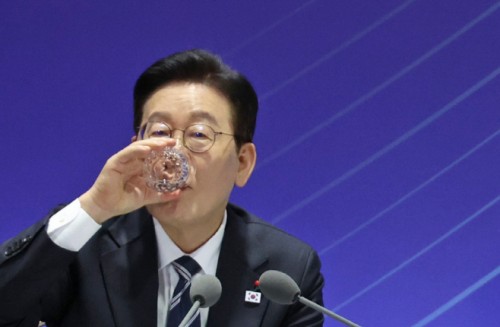 |
| President Lee Jae-myung drinks water during a town hall meeting titled “Listening to the People of Ulsan” at the Ulsan Exhibition and Convention Center on Jan. 23. / Yonhap |
President Lee Jae-myung’s push for bipartisan appointments aimed at national unity has hit an early obstacle, as controversies surrounding real estate and college admissions forced the withdrawal of a key cabinet nomination.
On Jan. 25, Lee rescinded the nomination of Lee Hye-hoon as minister of strategy and finance, raising questions over whether his “inclusive appointments” strategy can be sustained.
Lee had nominated Lee Hye-hoon, a conservative-leaning figure, as part of his broader message of unity and bipartisan cooperation. However, the nominee failed to provide convincing explanations during her confirmation hearing over allegations involving an improper apartment subscription in Seoul’s Gangnam district, preferential college admissions for her eldest son, and abusive treatment of aides.
The presidential office said Lee’s efforts to promote unity through cross-party appointments would continue, but opposition parties argued that the episode underscored the need for a far more rigorous personnel vetting system to ensure such messages resonate with the public.
According to the presidential office, Lee decided to withdraw the nomination after concluding that the nominee’s testimony was insufficient to dispel mounting public concerns and that negative public opinion was rapidly intensifying.
As recently as the morning of Jan. 25, the office had expected Lee to make a final decision after reviewing the National Assembly’s confirmation report, which was slated to be decided around Jan. 26 or 27. However, the president reportedly determined that delaying the decision further would only deepen public backlash.
Officials said Lee judged the allegations — touching on real estate and education, two of the most sensitive issues for South Koreans — would inevitably fuel stronger criticism the longer the process dragged on.
A senior official explained that while the administration initially planned to wait for the assembly’s report, uncertainty over its adoption and concerns that the issue could dominate state affairs into the following week prompted Lee to act swiftly.
The fact that the situation was resolved through a presidential withdrawal rather than the nominee’s voluntary resignation was seen as signaling Lee’s firm stance on the matter.
Presidential Chief of Staff Hong Ik-pyo said during a press briefing at the Chunchugwan that Lee had “fulfilled his responsibility as the appointing authority,” noting that the nominee had been drawn from the conservative camp.
Despite the administration’s intention to pursue national unity through inclusive appointments, critics said the failure to detect such controversies earlier amounted to a breakdown in personnel vetting.
The People Power Party demanded a direct apology from the president, accusing the presidential office of a verification failure.
Floor leader Song Eon-seok wrote on Facebook that the withdrawal came “far too late,” criticizing the administration for wasting more than 20 days on a nominee who should have been dropped earlier and questioning who would be held accountable for the resulting drain on national governance.
He described the episode as “a clear personnel disaster and a failure of vetting,” urging Lee to offer a formal apology and overhaul the screening system.
Lee Jun-seok, leader of the New Reform Party, echoed the call, writing on Facebook that he hoped the Lee administration would “regroup and strengthen its lax personnel verification framework.”
#Lee Jae-myung #personnel vetting #bipartisan appointments #real estate controversy #education scandal
Copyright by Asiatoday
Most Read
-
1
Trump shares map on social media labeling Strait o..

-
2
Kia Sportage outperforms Mazda CX-5 in German auto..

-
3
Houthis launch successive attacks on Saudi airport..

-
4
U.S. deploys carrier, 10,000 more troops to Middle..

-
5
Trump rejects Iran's offer to open Strait of Hormu..

-
6
N. Korea conducts first swarm attack drill with dr..

-
7
U.S.-China summit falls short on substance as Trum..

PEOPLE





HEADLINE NEWS
- Seoul dismisses Ukraine's claim of 'S. Korean support for Russia' as "inaccurate and inappropriate"
- S. Korea, Japan race to develop nuclear-powered submarines
- Henri Kagan, Kenso Soai win Nobel Prize in Chemistry for uncovering how mol..
- Vance says Alaska LNG cooperation will move forward with Seoul's current or..

-
Address : In-Young Bldg., 34, Uisadang-daero 1-gil, Yeongdeungpo-gu, Seoul
Copyright by ASIATODAY CO., LTD. All rights resereved