



Jung Cheong-rae faces backlash over unilateral merger bid
Jan 26, 2026, 08:51 am


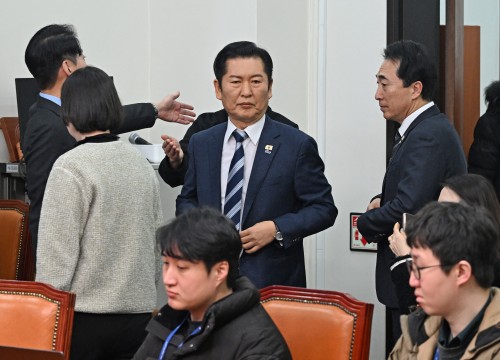 |
| Jung Cheong-rae, leader of the Democratic Party of Korea, is seen during a party event. / Photo by Song Eui-joo |
A proposal for a party merger has placed Jung Cheong-rae’s leadership style under intense scrutiny, with critics inside the ruling Democratic Party of Korea accusing him of unilateral decision-making that contradicts his long-championed principle of “party member sovereignty.”
Jung has simultaneously promoted a “one member, one vote” system for party members and pushed for a merger with the Cho Kuk Innovation Party. However, resistance has grown within the party, where lawmakers argue that the merger proposal was made without sufficient consultation and therefore runs counter to democratic procedures within the party.
Following Jung’s proposal, backlash intensified among Democratic Party members. Several first-term lawmakers, along with some members of the party’s supreme council, publicly criticized the move as unilateral and demanded an apology from the party leader.
Jung reportedly disclosed the merger proposal for the first time at an emergency meeting of the supreme council shortly before making it public, effectively notifying the leadership after the decision had already been made. The following day, supreme council members Lee Eon-ju, Kang Deuk-gu and Hwang Myung-sun held a press conference condemning what they called “Jung Cheong-rae-style unilateralism.”
“The Democratic Party is not Jung Cheong-rae’s private party,” they said, adding that the proposal constituted an overreach and an abuse of authority by the party leader.
As criticism mounted, Jung said the matter would ultimately be decided through discussions and a vote involving all party members. He also explained that the timing of the proposal was unavoidable if the merger was to be completed before the upcoming local elections.
Political observers, however, continue to question the consistency of Jung’s stance. While he has emphasized party member sovereignty through electoral reform within the party, critics argue that making a major decision such as a merger without prior consultation undermines that very principle. Hwang Myung-sun said the move “runs directly against the values of a party that claims to be governed by its members.”
Some within the party have gone further, suggesting that the merger proposal may be part of Jung’s own political calculations, possibly aimed at securing another term as party leader under the banner of winning local elections.
Others reject that interpretation. Party Secretary-General Cho Seung-rae argued that “self-serving politics” would involve sidelining potential rivals, noting that Jung instead proposed cooperation with Cho Kuk, a figure who could emerge as a political competitor.
The Democratic Party plans to proceed with internal debates before formally launching the merger process. Once discussions conclude, party members will vote on the proposal. If approved, the merger will then require formal endorsement by the central committee or a party convention of delegates.
#Jung Cheong-rae #Democratic Party of Korea #party merger #Cho Kuk Innovation Party #party member sovereignty
Copyright by Asiatoday
Most Read
-
1
Trump shares map on social media labeling Strait o..

-
2
Kia Sportage outperforms Mazda CX-5 in German auto..

-
3
Houthis launch successive attacks on Saudi airport..

-
4
U.S. deploys carrier, 10,000 more troops to Middle..

-
5
Trump rejects Iran's offer to open Strait of Hormu..

-
6
N. Korea conducts first swarm attack drill with dr..

-
7
U.S.-China summit falls short on substance as Trum..

PEOPLE




HEADLINE NEWS
- Seoul dismisses Ukraine's claim of 'S. Korean support for Russia' as "inaccurate and inappropriate"
- S. Korea, Japan race to develop nuclear-powered submarines
- Henri Kagan, Kenso Soai win Nobel Prize in Chemistry for uncovering how mol..
- Vance says Alaska LNG cooperation will move forward with Seoul's current or..

-
Address : In-Young Bldg., 34, Uisadang-daero 1-gil, Yeongdeungpo-gu, Seoul
Copyright by ASIATODAY CO., LTD. All rights resereved