



Ruling party grows cautious on probe powers
Jan 23, 2026, 07:57 am


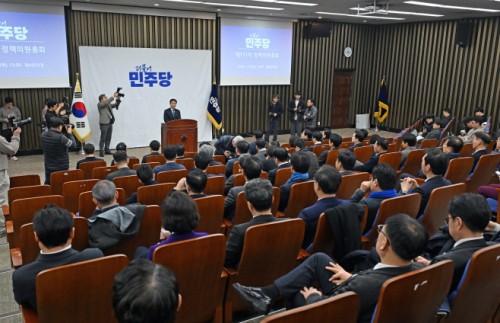 |
| Han Byung-do, floor leader of the Democratic Party of Korea, speaks at a policy caucus meeting at the National Assembly on Jan. 15. / Photo by Song Eui-ju |
Caution is spreading within the ruling Democratic Party of Korea over whether to retain supplementary investigation authority for the proposed Public Prosecution Office, after President Lee Jae-myung partially acknowledged the need for such powers.
The shift suggests a change in tone from earlier debates, when hard-liners largely favored abolishing the authority altogether. Lawmakers met from the morning of Jan. 22 at the National Assembly for a policy caucus to discuss prosecution reform bills, including legislation to establish the Major Crimes Investigation Office and the Public Prosecution Office.
Key points of contention include whether prosecutors should be allowed to conduct supplementary investigations, the scope of authority for the new investigation office, and how the dual-track system would operate. After Lee signaled conditional support for limited supplementary probe powers the previous day, discussion intensified over whether exceptions should be permitted.
At a seminar titled “What Completes Prosecution Reform,” Rep. Park Ji-won reiterated his opposition, saying investigation and prosecution must remain separate and that supplementary authority should not be granted. He added that the president’s remarks reflected concerns over the heavy caseload—about 1.5 million cases—many involving everyday crimes that police alone may struggle to handle, arguing that such issues could be addressed through detailed legislation.
During the caucus, however, some lawmakers openly supported retaining supplementary powers in limited circumstances, citing the president’s comments. It was the first time such views had surfaced so clearly within the party.
Kim Han-gyu, the party’s senior policy chief, said many lawmakers agreed that supplementary authority should be recognized on an exceptional basis, noting that opinions within the party were more diverse than media portrayals and that there was significant support for the government’s proposal.
The party plans to convene another caucus once lawmakers’ views are consolidated. While it aims to meet the legislative notice deadline of Jan. 26, party officials said the schedule would remain flexible.
#supplementary investigation authority #prosecution reform #Democratic Party of Korea #Lee Jae-myung #separation of investigation and prosecution
Copyright by Asiatoday
Most Read
-
1
Trump shares map on social media labeling Strait o..

-
2
Kia Sportage outperforms Mazda CX-5 in German auto..

-
3
Houthis launch successive attacks on Saudi airport..

-
4
U.S. deploys carrier, 10,000 more troops to Middle..

-
5
Trump rejects Iran's offer to open Strait of Hormu..

-
6
N. Korea conducts first swarm attack drill with dr..

-
7
U.S.-China summit falls short on substance as Trum..

PEOPLE





HEADLINE NEWS
- Seoul dismisses Ukraine's claim of 'S. Korean support for Russia' as "inaccurate and inappropriate"
- S. Korea, Japan race to develop nuclear-powered submarines
- Henri Kagan, Kenso Soai win Nobel Prize in Chemistry for uncovering how mol..
- Vance says Alaska LNG cooperation will move forward with Seoul's current or..

-
Address : In-Young Bldg., 34, Uisadang-daero 1-gil, Yeongdeungpo-gu, Seoul
Copyright by ASIATODAY CO., LTD. All rights resereved