



CES spotlight lifts humanoid robot ETFs
Jan 12, 2026, 07:49 am


 |
As humanoid robots emerged as a key theme at CES 2026, Korea’s asset management industry is stepping up competition to launch exchange-traded funds (ETFs) focused on the sector.
With the industry increasingly viewing 2026 as a turning point at which humanoid robots could reshape virtually every sector, asset managers are rolling out portfolio strategies that reflect regional strengths and value-chain advantages across South Korea, China, and the United States. From finished robot manufacturers to core components and software, these ETFs span the entire ecosystem—allowing investors to gain indirect exposure to what many see as a coming technological revolution.
According to a report released on Jan. 11 by the Overseas Economic Research Institute of the Export-Import Bank of Korea, the global humanoid robot market is expected to grow from $1.5 billion in 2025 to $37.5 billion by 2035, posting an average annual growth rate of 38%. UK market research firm Omdia estimates that about 13,000 humanoid robots were shipped worldwide last year. The Korean policy bank projects shipments will rise to 76,000 units in 2027, 502,000 in 2032, and 1.39 million in 2035—an average annual growth rate of 53%.
The bank noted that current demand for humanoid robots remains limited, largely confined to research and education, with most units still produced manually. However, it said multiple companies have announced plans to establish mass-production systems. Commercial deployment is expected to begin in logistics—where labor substitution demand is high and task complexity relatively low—before expanding into manufacturing and eventually household applications.
At CES 2026, the next-generation humanoid robot Atlas, unveiled by Hyundai Motor Group, captured global attention. CES official partner CNET named Atlas the best robot of this year’s show, praising its natural walking motion and noting that a near-production version is already prepared for deployment at Hyundai’s manufacturing facilities.
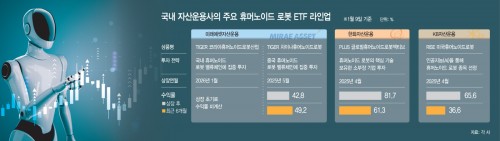
Riding this momentum, Mirae Asset Management has launched new humanoid robot–themed ETFs. On Jan. 6, it introduced the TIGER Korea Humanoid Robot Industry ETF, which focuses exclusively on pure-play humanoid robot companies across Korea’s full value chain. The product also features a fast-track inclusion system that allows newly listed promising companies to be quickly added to the portfolio.
The ETF sold out its initial 20 billion won allocation within just 15 minutes of listing. Strong market response followed a wave of announcements at CES 2026, where major companies revealed large-scale investments in physical AI. Hyundai Motor Group, for instance, said it plans to invest a total of 125 trillion won domestically through 2030 to build an AI robot ecosystem—the largest such commitment ever announced in Korea.
Mirae Asset’s TIGER China Humanoid Robot ETF, launched last year, focuses on China’s dominant manufacturing base. Leveraging its vast industrial infrastructure and cost competitiveness, China is seen as having unmatched mass-production capacity for humanoid robots. The ETF includes both leading Chinese robot makers and essential component suppliers critical to humanoid production.
Meanwhile, Hanwha Asset Management has taken a global approach with its PLUS Global Humanoid Robot Active ETF. While investing in leading humanoid robot developers such as Tesla and Rainbow Robotics, the fund also targets materials, components, and equipment suppliers—such as actuator and sensor companies—that underpin robot functionality.
KB Asset Management has launched the RISE U.S. Humanoid Robot ETF, which tracks humanoid-related firms listed on U.S. exchanges. The firm applies large language model (LLM)–based analysis to corporate disclosures and news, identifying U.S. stocks with strong links to the humanoid robot industry.
#humanoid robot #CES 2026 #ETF #physical AI #Hyundai Motor Group
Copyright by Asiatoday
Most Read
-
1
Celltrion’s Omlyclo gains ground in major European..

-
2
Trump demands rates fall below 1% as Fed hikes for..

-
3
Trump makes $1 trillion bet ahead of midterm elect..

-
4
Iran resumes ballistic missile production, assembl..

-
5
Trump warns countries not helping U.S. must pay re..

-
6
Apple launches first foldable, 1 million won prici..

-
7
Turkish Airlines named main club partner of Liverp..

PEOPLE







-
Address : In-Young Bldg., 34, Uisadang-daero 1-gil, Yeongdeungpo-gu, Seoul
Copyright by ASIATODAY CO., LTD. All rights resereved